

AI in Ecommerce
AI Product Image Generator: A Guide for Ecommerce Teams
Discover how an AI product image generator can cut costs and boost conversions. Our guide covers workflows, best practices, and ROI for ecommerce brands.
Jun 6, 2026
Read More
Discover how ChatGPT Shopping is transforming the eCommerce landscape. Strategies, market impact and how to adapt your business to the new AI era.
Discover how an AI product image generator can cut costs and boost conversions. Our guide covers workflows, best practices, and ROI for ecommerce brands.
Jun 6, 2026

Master ecommerce site search. Get UX best practices, analytics, & technical setups to boost conversions & revenue with product content.
May 19, 2026

Master photo editing for ecommerce. Learn scalable workflows, background removal, color correction, SEO & AI automation to boost conversions.
May 14, 2026
The eCommerce landscape is experiencing its most radical transformation since the emergence of Amazon. With the launch of ChatGPT Shopping by OpenAI, we are witnessing the birth of conversational commerce: an experience where users can discover, compare and buy products simply by conversing with artificial intelligence. According to WIRED, ChatGPT users already perform more than one billion web searches per week, and a significant portion of these queries is related to product research in categories like beauty, home and electronics.
🚀 Revolutionary fact: According to Lengow, 22% of shoppers already use AI for product discovery, with Generation Z being 10 times more likely than baby boomers to use AI frequently to discover new products.
This transformation is not simply a new feature; it represents a fundamental paradigm shift in how consumers interact with brands and make purchasing decisions. While traditional eCommerce requires users to navigate through multiple pages, compare prices in different tabs and face invasive ads, ChatGPT Shopping promises a fluid, personalized and distraction-free commercial experience. The question is not whether this change will affect your business, but how quickly you can adapt to avoid being left behind.
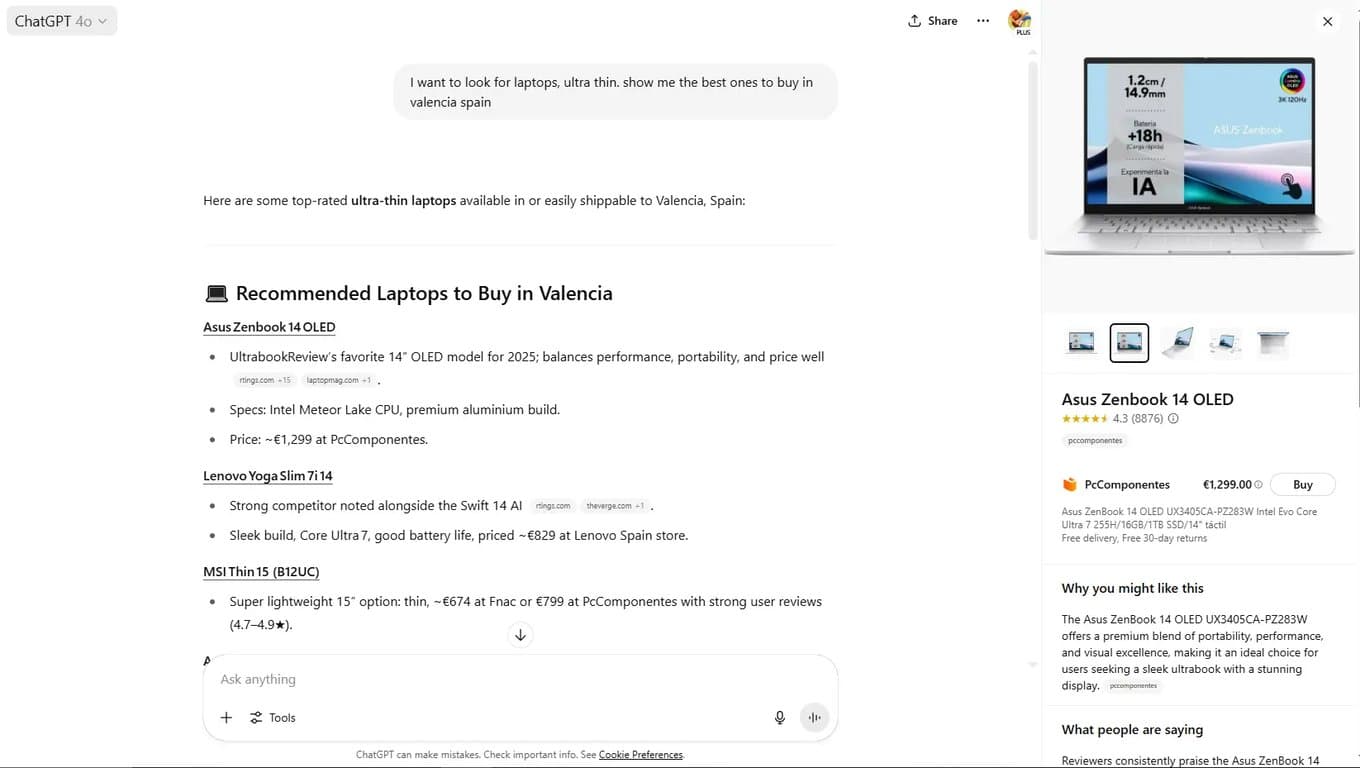
ChatGPT Shopping is much more than a simple product search functionality. It's a conversational shopping assistant that uses advanced artificial intelligence to understand users' specific needs and provide personalized recommendations in real time. Unlike traditional search engines that require specific keywords, ChatGPT Shopping allows natural queries like 'What coffee maker do you recommend for under $100?' or 'Show me white sneakers that are trendy'.
Elements that differentiate this platform from traditional shopping experiences:
The experience is powered by real-time purchase intent analysis, combining multiple signals: query content, user's previous interactions, commercial product relevance and popularity on merchant sites. According to Adam Fry, ChatGPT search product leader at OpenAI, the system 'doesn't look for specific signals in some algorithm', but tries to 'understand how people are reviewing this, how they talk about this, what are the pros and cons'. This conversational approach marks a fundamental difference from keyword-based searches on traditional platforms.
The introduction of ChatGPT Shopping is not just an isolated technological innovation; it represents an existential threat to traditional eCommerce acquisition channels. The impact is especially felt in three critical areas that define the success of any online business.
Radical transformation of the consumer purchase journey
Traditional eCommerce (Until 2024)
Fragmented and complex journey: Users navigate through multiple search engines (Google, Amazon), open dozens of tabs to compare prices, face invasive ads and sponsored results that distort real relevance. Process saturated with friction: from initial search to final decision, the user must manually filter biased commercial information.
Average research time: 45-60 min
AI Conversational Commerce (2025+)
Unified and frictionless experience: A single natural conversation provides curated recommendations, objective comparisons based on real reviews and direct access to multiple purchase options. Deep personalization: AI remembers preferences, understands context and adapts recommendations to the user's specific profile without requiring forms or complex configurations.
Average research time: 8-15 min
Fundamental Changes
The AI shopping landscape is consolidating around three main players, each with distinctive approaches and strengths. Understanding these differences is crucial for companies looking to optimize their visibility strategy.
Strengths: Most natural conversational experience, user preference memory, currently non-sponsored results, integration with over one billion weekly searches. Approach: Recommendations based on deep contextual understanding and multiple review analysis. Current limitation: Redirection to external sites to complete purchases (although a beta version with Shopify exists).
Growth: Exponential
Strengths: Visual search with 'Snap to Shop', direct checkout with benefits like free shipping, structured summaries by key points. Approach: Efficiency in comparison and quick purchase with select partners. Limitation: Recommendations limited only to current prompt, no memory between sessions.
Niche: Visual Shopping
Strengths: Established ecosystem with 4+ billion users, deep integration with Google Ads, 'Researched with AI' section that combines AI with traditional search. Approach: Gradual evolution of existing advertising model with AI layers. Limitation: Dominance of sponsored results that may compromise recommendation objectivity.
Reach: Massive
Adapting to conversational commerce requires a fundamental transformation in how companies structure and present their product information. It's not enough to optimize for traditional SEO; now you need to master GEO (Generative Engine Optimization), a completely new discipline that determines your visibility in AI engines.
GEO is the new SEO, but operates under completely different principles. While SEO focuses on ranking algorithms, GEO requires your content to be understandable and attractive to AI systems that synthesize responses based on purchase intent.
Tip:
⏱️ 2-3 months for complete implementation
AI engines prioritize content that sounds natural and directly responds to how people ask in real conversations. This requires moving away from rigid technical descriptions toward more human and contextually rich narratives.
Tip:
⏱️ 4-6 weeks per product category
Reputation signals are key factors in ChatGPT Shopping ranking. AI extracts information from real reviews across multiple sources, including your store, social media and external review sites like Google, Trustpilot and Reddit.
Tip:
⏱️ Ongoing process, results in 3-6 months
The conversational commerce landscape will evolve rapidly in the coming years. Based on current trends and technological roadmaps from major AI companies, several scenarios emerge that will define the future of eCommerce.
2025-2026: Development of AI agents specialized in specific niches. A fashion expert agent that understands trends, sizes and personal styles. Another specialized in technology that compares complex technical specifications. Impact: Greater precision in recommendations and hyperpersonalized experiences by sector.
Probability: 85%
2026-2027: AI agents will integrate AR capabilities to allow 'trying' products virtually before buying. Visualize furniture in your home, try on clothes digitally or see how beauty products look. Impact: Drastic reduction in returns and increased confidence in online purchases.
Probability: 70%
2027+: Complete transactions without leaving the AI interface. Automated price negotiation, conversational return management, integrated post-sale support. Impact: Traditional product pages could become obsolete, replaced by fluid conversational experiences.
Probability: 60%
🔮 Key prediction: By 2027, 40% of online purchases in high-consideration categories (electronics, fashion, home) will begin with a conversational query to an AI, not with a traditional search on Google or Amazon.
Successful implementation of AI shopping strategies varies significantly by sector and product type. These real cases show how different companies are adapting to the new paradigm.
Real examples of companies that have successfully optimized for ChatGPT Shopping and similar AI platforms:
Implemented Sectors: