

Ecommerce SEO
Guide to Rich Snippets Products: Boost CTR in 2026
Learn to implement rich snippets products to boost CTR & visibility. Our 2026 guide covers JSON-LD, testing, and common eCommerce pitfalls for success.
Jun 13, 2026
Read More
Learn how to write SEO product descriptions that rank on Google and convert. From keyword research to AI automation and structured data strategies.

Quick answers to common questions.
Learn to implement rich snippets products to boost CTR & visibility. Our 2026 guide covers JSON-LD, testing, and common eCommerce pitfalls for success.
Jun 13, 2026

Create powerful tone of voice guidelines for e-commerce. Define, document, & scale your brand voice for product copy, SEO, and AI success.
Jun 11, 2026

Explore 10 actionable writing strategy examples for eCommerce. Learn SEO-first content, storytelling, and data-driven methods to boost traffic and sales.
Jun 10, 2026
In the high-stakes landscape of 2026 eCommerce, seo for product descriptions has evolved from a simple checklist item to a critical revenue driver. For years, eCommerce teams have overlooked the humble Product Detail Page (PDP), often resorting to carbon-copying manufacturer data or leaving fields blank. This negligence triggers significant duplicate content penalties and missed opportunities in AI-driven search snapshots.
A well-crafted product description is no longer just text; it is your most efficient salesperson, working 24/7 to bridge the gap between user intent and checkout. For SEO Leads and CTOs, the challenge lies in balancing the need for unique, high-quality content with the operational cost of managing a massive catalog. Relying on outdated methods is a bottleneck for growth. To stay competitive, you must optimize for both human psychology and machine learning algorithms.

Whether you are looking for a product description generator to scale your efforts or manually refining your top-tier items, understanding how to optimize product descriptions for eCommerce is non-negotiable. In an era where Google favors Helpful Content and experiential data, your descriptions must provide unique value that generic AI outputs cannot replicate without proper grounding.
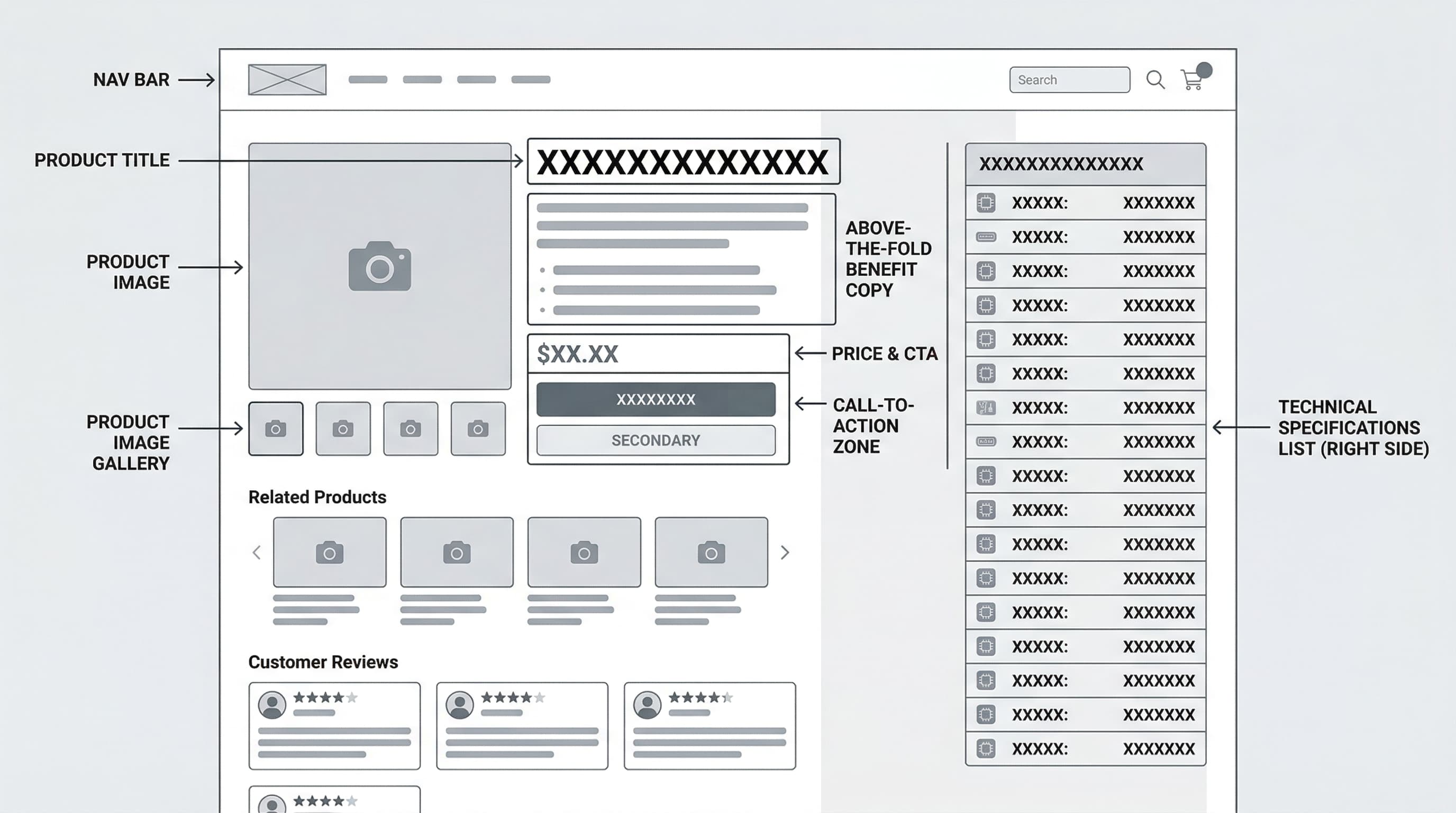
When auditing extensive eCommerce catalogs, a clear pattern emerges among the top-performing domains. The most successful Product Detail Pages share a specific anatomy that effectively caters to both search engine crawlers and human buyers. A product page is not merely a digital flyer; it is a structured data asset designed to capture intent and drive action.
To win in organic search, you must go beyond basic text blocks. Your content structure needs to break down complex product information into easily digestible, semantic components. This means implementing proper heading hierarchies, utilizing bullet points for rapid scannability, and creating distinct sections that separate technical features from tangible user benefits.
The first viewport is the most critical real estate on your site. Search engines place significantly higher weight on the text that appears immediately upon page load. Your primary keyword must naturally exist within the main product title and the very first paragraph. This initial text should be highly direct, stating exactly what the product is, who it is designed for, and the primary problem it resolves. Avoid wasting this crucial section on generic marketing fluff.
A persistent mistake in catalog management is listing raw technical specifications without any surrounding context. While a product manager might care about a high-density lithium-ion battery, the average consumer only cares that the device lasts two full days on a single charge. Your SEO copy must bridge this technical gap. Search queries often include the desired benefit rather than the exact specification. By including both the specification and its corresponding benefit, you capture a much wider range of search intent and improve your overall topical authority.
When retailers rely strictly on vendor-supplied product feeds, they inherit the exact same descriptions used by hundreds of other competing stores. Search engines employ strict deduplication algorithms to ensure a diverse set of results. When multiple domains present the exact same text, the algorithm must choose a canonical source, usually prioritizing the original manufacturer or the domain with the highest established authority.
If your site is not chosen as the primary source, your product page is effectively filtered out of the main search results, relegated to the omitted results pages where no potential buyer will ever find it. Rewriting manufacturer descriptions is the only reliable defense against this severe visibility penalty.
However, rewriting thousands of descriptions manually to achieve uniqueness is mathematically unviable for most teams. Automated rewriting systems specifically designed for retail environments can ingest the standard vendor feed and output completely unique, brand-aligned descriptions. This foundational step ensures your site avoids deduplication filters and competes effectively for organic visibility.
Keyword research for product descriptions requires a fundamentally different approach than traditional blog SEO. You are targeting users at the absolute bottom of the marketing funnel, where purchase intent is at its peak.
Users who are ready to buy use specific transactional modifiers. Words like 'buy', 'discount', 'size', 'color', 'dimensions', or 'compatible with' frequently accompany the base product names. Your product descriptions must naturally integrate these modifiers. Instead of broadly targeting a term like 'running shoes', your copy should target the long-tail variation such as 'lightweight trail running shoes for men'. This specificity significantly increases your conversion rate.
Modern search algorithms rely on Natural Language Processing to understand contextual relevance. If you are selling a premium leather jacket, the algorithm inherently expects to see related terms like 'zipper', 'lining', 'stitching', 'durability', and 'fit'. A robust automation engine configured with the proper semantic parameters will automatically weave these contextual signals into the text, elevating your relevance score without resulting in unnatural keyword stuffing.
Human attention spans are shorter than ever. When a user lands on a product page from a search result, they do not read the page like a book; they scan it for specific information. Your SEO and content strategy must directly align with this established behavior.
Eye-tracking studies consistently demonstrate that users read web pages in an F-shaped pattern. They read the top headline, scan down the left side of the page, and read across only when a specific element catches their eye. Your product descriptions must be formatted to exploit this natural tendency. Front-load your most important keywords and selling points in the first sentences of every paragraph. Use bold text to highlight key features, and keep paragraphs concise, ideally under three sentences.
Every potential buyer arrives on your site with friction points and doubts. They wonder about fit, durability, or setup complexity. A truly optimized product description anticipates and resolves these objections directly within the text, long before the user has to search for a separate FAQ page. By mapping common customer service inquiries to your product copy, you improve conversion rates while naturally integrating question-based keywords that trigger rich search features.

Scaling high-quality SEO content across tens of thousands of individual SKUs is the defining operational challenge for modern eCommerce managers. Manual writing is incredibly slow, prohibitively expensive, and highly prone to inconsistencies in tone and formatting. Ignoring this bottleneck leads to massive amounts of thin content across your domain.
This is exactly where intelligent automation becomes your strongest lever. By utilizing platforms designed specifically for the complexities of retail catalogs, teams can generate highly optimized, unique content at an unprecedented scale. The foundational element of this success is structured input. Automation requires accurate product attributes to generate factual, compelling, and compliant copy.
A Product Information Management (PIM) system acts as a central hub to store, enrich, and distribute product data across all your sales channels. PIM software ensures that your product data is organized and accessible. Without a clean PIM or an organized product feed, automation will simply scale errors rather than generating solutions. Ensure your source data is accurate, complete, and properly formatted before applying any generation layer. When your source data is highly structured, automation can instantly transform raw, uninspiring specifications into persuasive, SEO-rich narratives.
Excellent written content must be supported by a flawless technical infrastructure. Search engines heavily rely on structured data to populate rich results, such as real-time pricing, stock availability, and user review stars directly in the search engine results page.
Schema markup is standardized HTML code added to your site that helps search engines explicitly understand the context of your data, enabling these highly visible rich snippets. For eCommerce stores, Product and Offer schema are absolutely mandatory. However, to populate this schema effectively, your eCommerce platform needs to house the right data fields.
This is precisely where customized data fields come into play. Shopify Metafields, for example, are custom data storage solutions within Shopify that allow you to store additional, highly specific product information that is not included in the standard platform setup. They are essential for storing granular attributes like exact material composition, specific care instructions, or warranty periods.
By utilizing a Shopify product metafields generator, you can automatically extract and format technical data directly from your descriptions. This structured approach directly influences your visibility in competitive product feeds, ensuring that Google Shopping algorithms can parse your specific product attributes flawlessly.
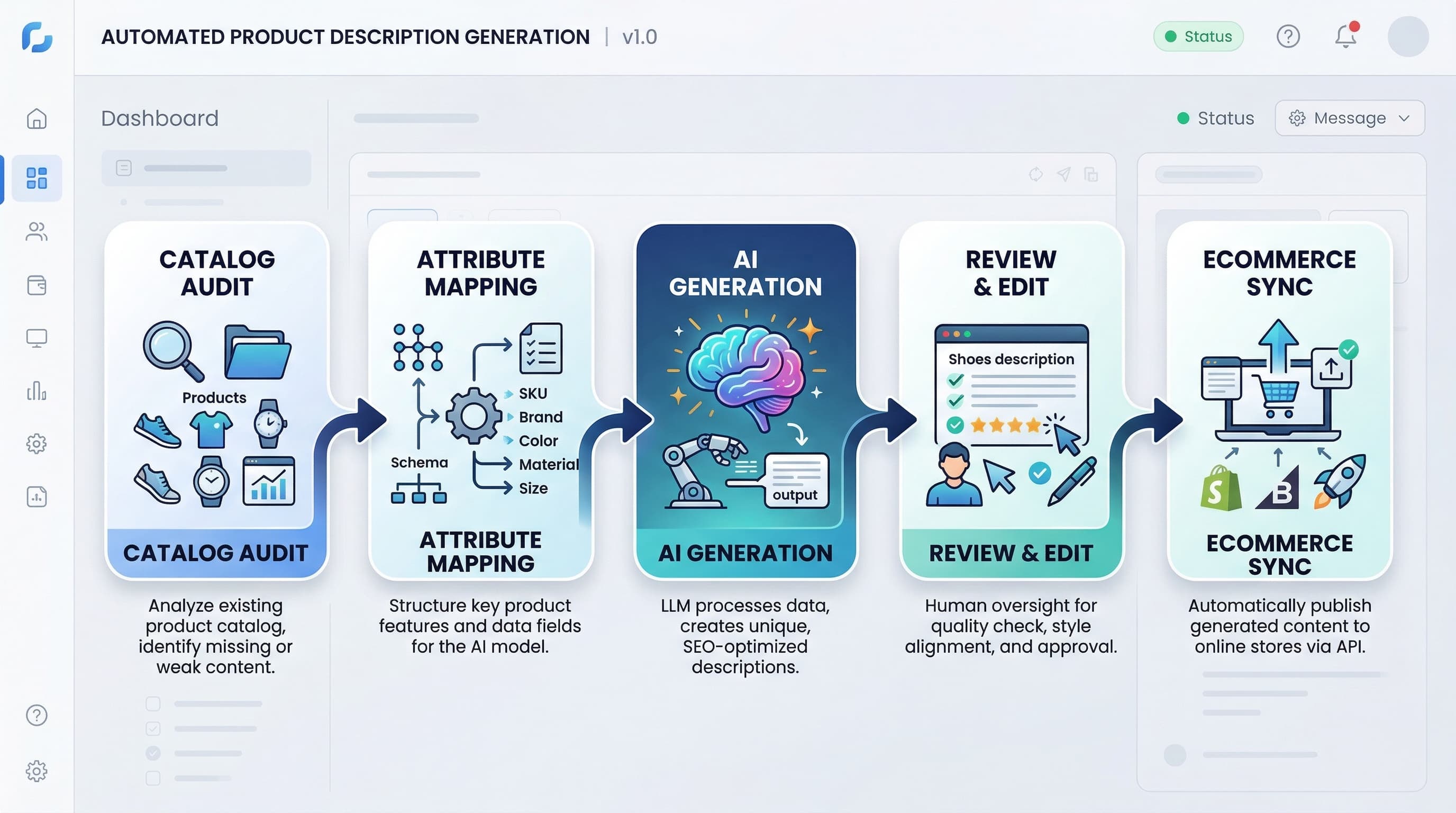
To safely transition from manual workflow bottlenecks to an automated, high-output production line, follow this structured and proven operational process.
Do not attempt to automate your entire catalog at once. Divide your product inventory into strategic tiers. Tier 1 includes your highest margin, highest volume products that drive the majority of revenue. Tier 3 includes legacy items or low-margin accessories. Start your automated generation process on Tier 2 and Tier 3 to safely test the output quality, keeping strict manual oversight on your Tier 1 items until the automated system is fully calibrated.
Your brand voice must remain completely consistent across all channels. Document your required tone: Is it highly technical, playful, luxury, or aggressively minimalist? Establish strict negative constraints, such as explicitly forbidding the use of the word 'cheap' or requiring that the copy always highlights sustainability features.
Ensure every product category has its required attributes mapped out. A t-shirt requires data points like 'fabric weight', 'fit type', and 'care instructions'. A laptop requires 'RAM capacity', 'processor speed', and 'battery life'. This mapping ensures the generated text is always factual.
Deploy tailored generation parameters that incorporate your brand voice and map directly to your specific product attributes. Run a small batch of 50 to 100 products initially. Review these outputs for formatting, accuracy, and flow, and refine your systemic instructions accordingly.
Implement a rigid human-in-the-loop review process. An SEO specialist or copywriter should spot-check the generated descriptions before syncing the final, approved text back to your eCommerce platform via a direct API connection or a bulk CSV import.
Generating thousands of optimized descriptions is only half the battle; proving the financial ROI of this effort is your ultimate goal. You must track specific performance indicators to validate your product catalog strategy.
Monitor your non-branded organic traffic explicitly at the PDP level. Look for consistent increases in search impressions for long-tail, feature-specific search queries. If your descriptions are thoroughly optimized, you will naturally start ranking for highly specific, feature-based searches that you previously ignored.
Traffic without actual sales is a useless vanity metric. Analyze the Time on Page and Add to Cart rates for your updated products. A well-written, structurally sound description keeps the user engaged, aggressively answers their internal objections, and builds enough brand trust to drive the actual click. Furthermore, closely monitor your Return Rate. Accurate, highly detailed descriptions set the correct buyer expectations, which naturally reduces the number of costly returns due to an item being 'not as described'.
| Strategic Metric | Manual Writing Process | AI Automation (Structured) |
|---|---|---|
| Speed to Market | Weeks to Months per batch | Hours to Days |
| Cost per SKU | Extremely High | Very Low |
| SEO Consistency | Highly Variable | Strictly Consistent |
| Scaling Capacity | Hard limited by headcount | Virtually Unlimited |
| Brand Voice Adherence | Subjective to individual writer | Strict rule-based adherence |
Embracing comprehensive SEO for product descriptions is no longer an optional strategy. By combining robust technical architecture, deep semantic keyword strategies, and scalable automation workflows, you can completely transform your static catalog into a massive, compounding organic growth engine. The eCommerce teams that successfully automate the heavy lifting while maintaining strict quality control over their data will inevitably dominate the search results and capture the highest intent buyers in the market.