

Ecommerce SEO
Guide to Rich Snippets Products: Boost CTR in 2026
Learn to implement rich snippets products to boost CTR & visibility. Our 2026 guide covers JSON-LD, testing, and common eCommerce pitfalls for success.
Jun 13, 2026
Read More
Learn how to turn a Shopify blog into an organic growth engine with SEO structure, informational keyword targeting, internal linking, and conversion-focused content that lowers CAC, builds authority, and sends qualified readers into your product pages.

Quick answers to common questions.
Learn to implement rich snippets products to boost CTR & visibility. Our 2026 guide covers JSON-LD, testing, and common eCommerce pitfalls for success.
Jun 13, 2026

Create powerful tone of voice guidelines for e-commerce. Define, document, & scale your brand voice for product copy, SEO, and AI success.
Jun 11, 2026

Explore 10 actionable writing strategy examples for eCommerce. Learn SEO-first content, storytelling, and data-driven methods to boost traffic and sales.
Jun 10, 2026
In the current eCommerce landscape, Customer Acquisition Cost (CAC) has become a primary bottleneck for growth. Recent data suggests that the average eCommerce CAC across categories is hovering around $78, marking a 40% increase in just two years. For brands relying heavily on paid social, these rising costs threaten margins and long-term sustainability. This is where a strategic approach to the native Shopify blogging engine transitions from a simple news feed into a vital business lever for reducing reliance on performance ads.
The built-in Shopify blog is often overlooked by eCommerce managers who view it merely as a place for PR updates. However, it is a formidable tool for capturing top-of-funnel (ToFu) traffic. By answering informational queries that precede the intent to buy, you can establish authority and lower your overall blended acquisition cost.

In this blueprint, we provide a practical framework to transform your Shopify store into a content powerhouse. We will cover technical configuration, search engine optimization best practices, and methods to bridge the gap between educational reading and product conversion. Whether you are scaling from scratch or optimizing an existing catalog, mastering SEO for product pages and blog content is essential for 2026.
A blog on Shopify is not a secondary project; it is a strategic asset designed to lower your Customer Acquisition Cost (CAC) and diversify your traffic sources beyond paid ads. In a landscape where advertising costs continue to rise, a native blog serves as a long-term investment in owned media.
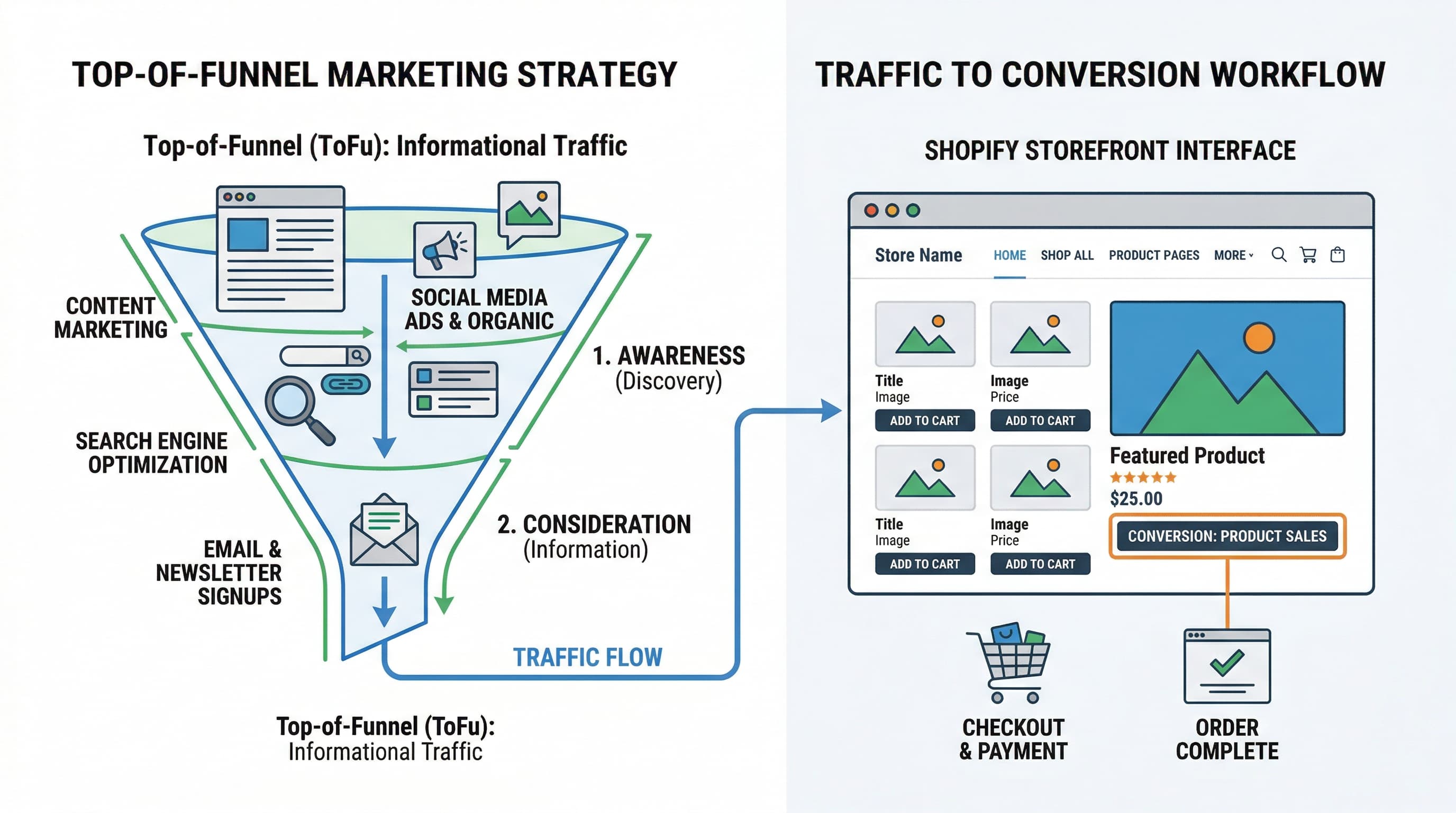
While product pages target high-intent transactional keywords, a blog captures the vast volume of informational searches. Users often look for solutions to their problems long before they decide on a specific purchase. By creating high-quality SEO content, you position your store as the first touchpoint in the consumer journey. This top-of-funnel traffic is essential for building brand awareness without the high price tag of direct search ads.
Topical authority is a measure of how much expertise a website has on a specific subject. Google uses signals from your blog to determine if your store is a credible source in your niche. A robust blog supports your product visibility by creating a network of internal links that signal importance to search engines. When search bots crawl your site and find clusters of highly relevant, well-researched articles linking back to specific category pages, they attribute higher ranking power to those transactional pages. According to 2025 data from Orbit Media, bloggers who prioritize high-quality research and expertise are the most likely to report strong results.
Content is the primary fuel for your retention loops. Instead of sending repetitive promotional emails, you can share how-to guides or industry insights via email, SMS, and social media. This keeps your brand top-of-mind without causing promotional fatigue. A blog provides a reason for customers to return to your site between purchases, increasing lifetime value (LTV). By acting as a central hub, your blog allows you to repurpose content across all marketing channels efficiently.
Welcome to the MDX section of this document. Setting up your blog correctly in Shopify is the foundation for reducing dependency on paid acquisition. While the platform is user-friendly, eCommerce managers must understand how the admin handles content hierarchy to ensure maximum crawlability and a professional user experience. This is a test section to verify your layout before going live with the strategy. Efficiently navigating the Online Store menu for structural setup and the Content menu for asset management is your first step towards building a scalable architecture.
Shopify distinguishes between a Blog (the folder or category) and a Blog Post (the individual article). By default, Shopify provides a blog titled News, but you can create multiple blogs to segment your strategy (e.g., Tutorials, Case Studies, or Product News).
Engagement signals can improve ranking, but automated spam can severely hurt your domain authority. Shopify allows you to control this at the blog level to maintain a clean content profile.

A blog only generates organic traffic if it is easily accessible to users and search bots. Without a link in your primary navigation, search spiders may struggle to index new posts.
For teams managing complex catalogs, linking these articles to high-value pages ensures a cohesive journey from information to purchase.
Actionable Setup Checklist:
Scaling a Shopify store requires moving beyond basic product listings. To capture users before they are ready to buy, you must master informational SEO. This approach builds authority and creates a cost-effective alternative to rising PPC costs. The core problem many stores face is generating traffic that never buys. The solution lies in building a semantic bridge through technical linking and optimization. Without this bridge, you attract readers but fail to convert them into customers.
While high-volume head terms are tempting, long-tail keywords, specific queries usually three words or longer, account for roughly 70 percent of all search traffic. In Shopify, this means moving from generic product terms to targeted educational topics.
Targeting informational intent allows you to capture prospects at the awareness stage. According to SEO guidelines, focusing on keywords where Google ranks guides or blogs is the signal that informational content is preferred.
Example: Instead of competing for generic terms, write a post addressing specific customer pain points. Error: Targeting buying keywords with blog posts, which often leads to poor rankings as Google prefers product pages for those queries.
Internal linking is the bridge between a reader and a customer. A 2024 study by FirstPageSage ranks internal linking as a top five on-page factor.
Use descriptive anchor text to link from your blog to relevant collections or product pages. For advanced users, utilize Shopify Metafields, extra data fields that allow you to store custom information, to programmatically display related products at the end of every blog post. Additionally, keeping your Product Information Management (PIM) system, a centralized hub for all product data, synchronized ensures that the metadata you pull into blogs is accurate. You can also integrate an XML Product Feed, a structured file containing a list of your products and attributes, to display live inventory blocks dynamically within your long-form content. Adding Schema Markup, a structured data vocabulary that helps search engines understand your content context, further boosts visibility in Rich Snippets. This ensures your blog traffic does not hit a dead end and passes link equity to your revenue-generating pages.
Visual content is a major traffic driver through Google Images. Every image in your blog must have descriptive Alt Text, which is the text description that appears if an image fails to load and helps screen readers. This is not just for accessibility; it is a critical SEO signal.
Manually writing alt text for every blog and product image is time-consuming. Leveraging bulk content generation can automate this at scale, ensuring every visual element contributes to your visibility.
By following these steps, you turn a simple article into a high-performance asset that supports your entire product strategy.
Deciding between Shopify built-in tool and an external platform is a choice between simplicity and control. While the native editor is basic, its structural alignment with your store provides a powerful head start for organic visibility without needing complex third-party configurations.
Shopify utilizes a subfolder structure (e.g., /blogs/news), which is superior for SEO. Search engines treat subfolders as part of the primary domain, meaning every backlink to your blog directly boosts the authority of your product pages. Conversely, hosting a blog on a subdomain (like blog.brand.com) often results in authority leakage, where the blog and store are viewed as distinct entities. According to research on subdomain versus subdirectory performance, subfolders generally perform better for consolidating ranking power. Leveraging this native structure allows your content to lift the entire site performance.
If your brand requires complex content relationships or bespoke layouts, the native engine may feel restrictive. Apps like Magefan allow for advanced tagging and related-product blocks. For extreme cases, a headless WordPress setup or a reverse proxy provides full CMS flexibility but requires technical maintenance. For most, optimizing alongside a native blog is the most cost-effective approach to scale.
| Feature | Native Shopify | WordPress (External) |
|---|---|---|
| SEO Structure | Subfolder | Subdomain |
| Setup | Instant | High Effort |
| Customization | Basic | Unlimited |
| Maintenance | Included in Shopify Plan | High Technical Debt |
Blogging on Shopify is a strategic investment in a scalable asset that reduces long-term reliance on paid advertising. By consistently addressing customer pain points, you build authority and guide prospects through every stage of the funnel. Success requires focus: identify high-intent keywords and create value-driven content.

To streamline production, leverage automation tools to maintain a steady publishing rhythm. Don't let analysis paralysis stall your growth. Research your first keyword today, map out a structured content calendar, and follow the best practices to stay competitive. Start publishing now to transform informational traffic into revenue-generating customers, securing a sustainable and profitable future for your eCommerce brand.