

How to Optimize Collections in Shopify to Improve Your SEO
Learn how to optimize collections in Shopify to scale your SEO. Automate descriptions and metadata with ButterflAI to improve rankings.
Optimize Shopify titles in bulk with AI. Improve your products' SEO and increase sales automatically and professionally.
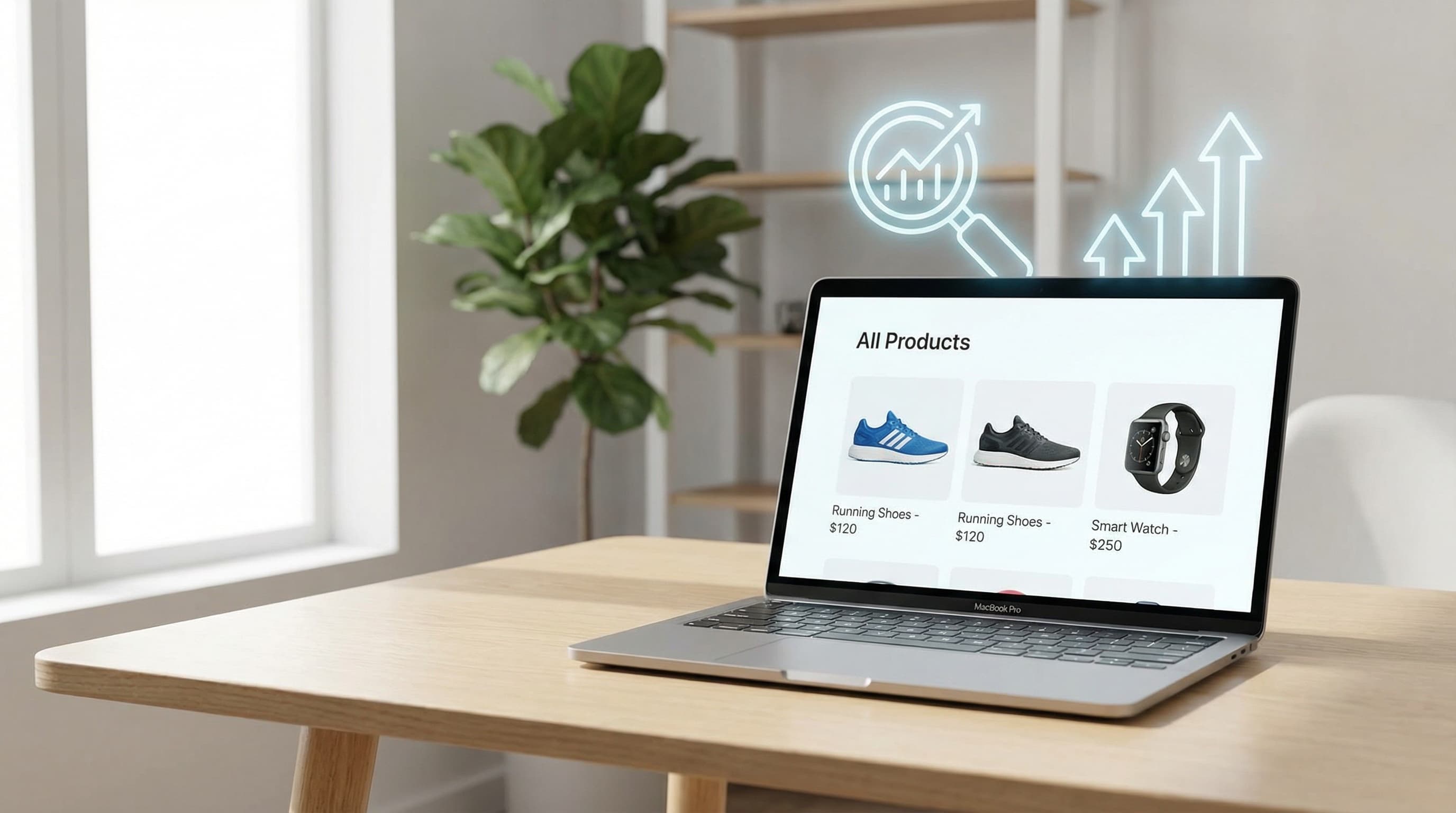
Optimizing titles in Shopify is key for visibility and CTR. With large catalogs, manual work is unfeasible. Discover how ButterflAI's AI transforms your titles automatically, turning them into high-performance assets for your store.
Scaling a Shopify store often hits an invisible ceiling: catalog management. When a store grows from 50 to 5,000 products, the task to optimize product titles in Shopify manually shifts from a chore to a logistical nightmare.
The native Shopify bulk editor is a linear tool designed for minor adjustments, not strategic SEO overhauls. It cannot suggest semantic improvements, detect missing high-intent keywords, or apply a consistent naming logic across thousands of SKUs simultaneously. This limitation often forces merchants to settle for generic titles (e.g., "Blue Shirt - V1") or rely on copy-pasted supplier data.
These generic titles are invisible to search engines and unappealing to humans. The real problem isn't just the time lost; it is the data inconsistency. Different team members might name products differently, fragmenting your store's structure. Without an automated, intelligent methodology, your product SEO is left to human error and fatigue, resulting in low Click-Through Rates (CTR) and lost sales to competitors who structure their data effectively.
ButterflAI redefines catalog management on Shopify by using an agentic AI approach. Instead of editing cell-by-cell, our platform acts as a senior SEO copywriter that analyzes every product in your store to generate titles that rank and convert.
Our solution integrates directly with your Shopify store or processes data via CSV. It extracts not just the current title, but also the description, tags, product type, and metafields. With this 360-degree view, ButterflAI's AI reconstructs titles following proven Shopify SEO best practices and your specific brand guidelines.
What used to take weeks of manual data entry is now resolved in minutes. ButterflAI doesn't just fill blanks; it understands context. If you sell electronics, it prioritizes model numbers and specs. If you sell fashion, it focuses on material, fit, and occasion. The result is a uniform, professional catalog designed to scale in Google SERPs and Shopify’s internal search.
Optimizing your catalog at scale with ButterflAI is a structured process designed to give you full control without the manual grunt work. Here is how you can transform your product titles:
[Brand] + [Product Name] + [Material] + [Color]) or allow the AI to determine the best structure based on the product category.See how data-driven AI optimization transforms weak, generic inputs into high-performing SEO assets.
| Before | After |
|---|---|
Title: Sports T-Shirt 2024 | Title: Men's Breathable Running T-Shirt - Navy Blue - 2024 Collection | ButterflAI Sports |
Hidden Attributes: Breathable fabric, navy blue, running specific, proprietary brand. | Hidden Attributes: High-intent keywords (running, breathable, men's) are now front-loaded. Color and brand are included to capture long-tail searches and assist Shopify's collection filters. |
SEO Status: Very low. Fails to target specific search intent. | SEO Status: Nordic Style Oak Wood Extendable Dining Table - 6 Seats | Sturdy & Elegant |
Title: Nordic Dining Table | Title: Technical specs (extendable, oak wood, 6 seats) are added. This increases buyer confidence and targets users searching for specific furniture features rather than just a style. |
Hidden Attributes: Oak wood, seats 6 people, extendable mechanism. | Hidden Attributes: — |
SEO Status: Generic. High competition, low differentiation. | SEO Status: — |
While AI optimization is powerful, understanding its boundaries ensures the best deployment for your Shopify store:
Automating titles in Shopify is versatile and adapts to various stages of an eCommerce business lifecycle:
Does the title place the primary keyword near the beginning?
Have you avoided using ALL CAPS?
Is the material or primary feature clearly mentioned?
Is the title length between 50 and 70 characters to prevent Google truncation?
Is the brand name included (if it has search volume)?
Is the title unique and not duplicated across variants?
Have stop words and "fluff" (like "Free Shipping") been removed?
are size, color, or model included if relevant to the purchase decision?
Does the title read naturally to a human?
Have you checked for special characters that might break URLs?
Quick answers to common questions.
Related guides
Keep exploring the best ways to optimize Shopify catalogs with guides that match this topic.
Learn how to optimize collections in Shopify to scale your SEO. Automate descriptions and metadata with ButterflAI to improve rankings.

Learn how to optimize product descriptions in Shopify at scale. Improve SEO and sales with eCommerce automation and AI. Upgrade your catalog today!

Learn how to optimize products in Shopify in bulk. Improve SEO, titles, and descriptions with AI to scale your eCommerce sales effectively.