

Catalog & Data Management
Google Shopping Feed Optimization: The QA Scorecard
A practical QA scorecard and weekly workflow to prevent Merchant Center disapprovals, optimize your product data, and scale catalog growth.
Mar 4, 2026
Read More
Optimize your catalog with this eCommerce audit guide. Learn to evaluate listing quality and bulk-correct data using AI to improve SEO.

Maintaining an optimized catalog of thousands of products is one of the biggest operational challenges for any eCommerce team. When information is fragmented, titles lack keywords, and descriptions are generic, store performance stalls despite marketing investments.
A lack of solid data structure not only affects search engine positioning but also creates distrust in the end user. A catalog with errors, incomplete attributes, or poorly labeled images is a constant leak of conversions and advertising budget.
In this guide, you will learn how to execute a professional eCommerce audit, establish a quality scoring system, and use Artificial Intelligence to automate the correction of your listings at scale.
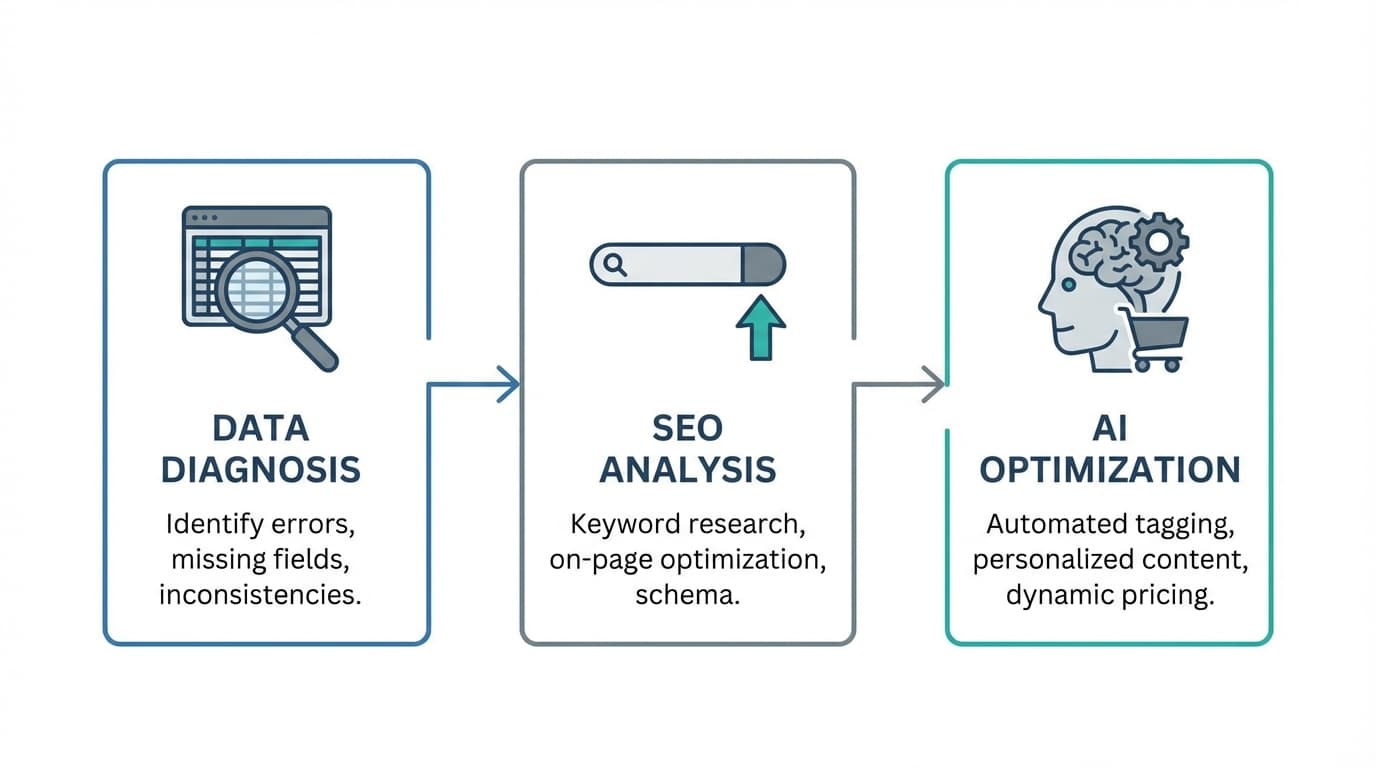
The foundation of any successful eCommerce audit lies in database integrity. A common mistake is focusing only on the visual aspects, ignoring that navigation filters and internal searches depend directly on the quality of attributes and Shopify metafields or custom PIM (Product Information Management) fields.
To evaluate the technical health of your catalog, you must verify data consistency at all levels. According to recent reports on eCommerce trends for 2025, the accuracy of product information is the number one factor in reducing returns and improving consumer trust.
Naming convention example:
Common error: Ignoring hidden fields. Many teams forget to audit fields that are not visible on the product page but are vital for the Google Shopping feed.
A professional SEO audit is not just about finding keywords; it’s about understanding how the content structure responds to user search intent. In today’s environment, listing optimization requires a balance between human readability and algorithm indexability.
Search engines and marketplaces prioritize products that offer a clear and structured response. A well-audited product description should contain "what it is," "what it's for," and "why to choose it."
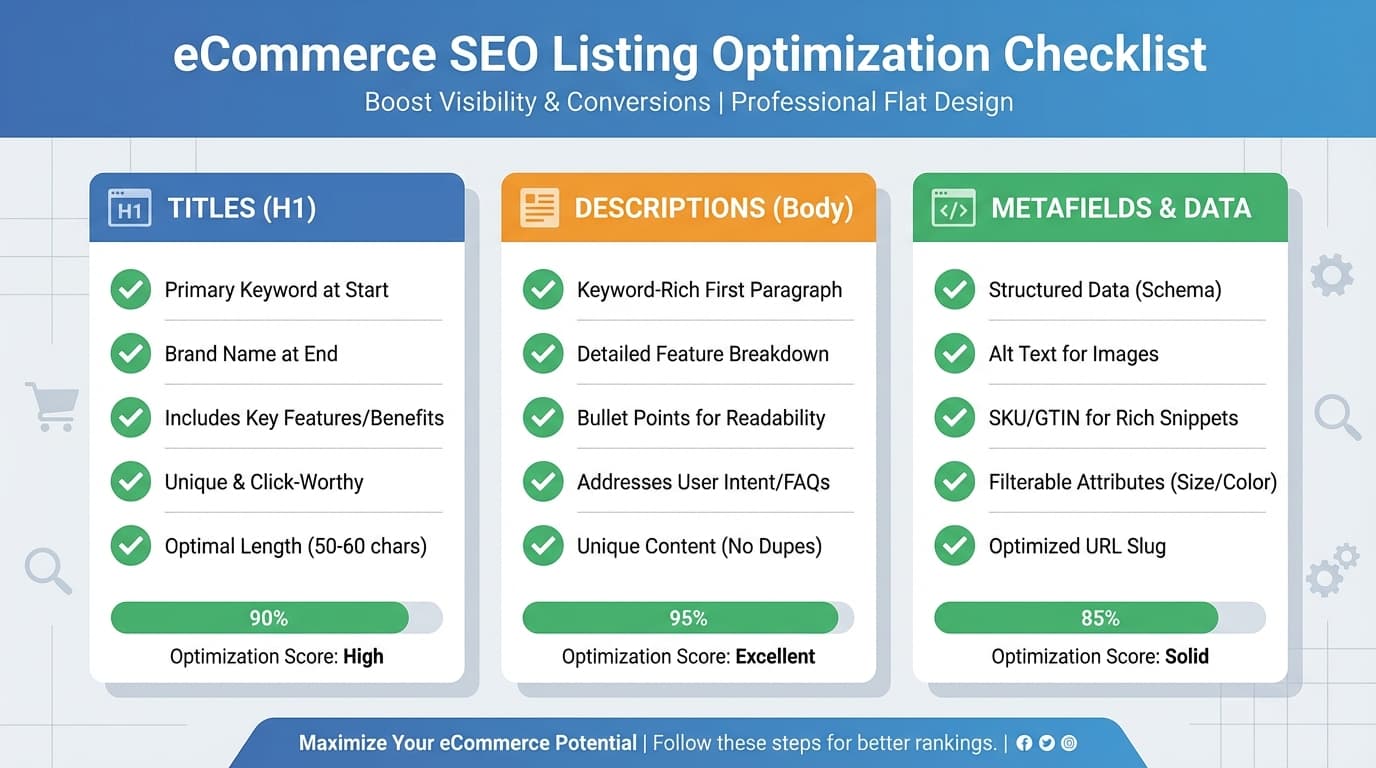
Ideal description format:
Common error: Using the manufacturer's description. This creates massive duplicate content, penalizing your store's organic positioning against the competition.
Managing a large-scale product catalog manually is impossible. This is where AI-assisted eCommerce data quality comes in. The first step is to establish a "Product Quality Score" (PQS) that rates each listing from 0 to 100.
Implementing an automatic scoring system allows content teams to focus only on low-scoring products, optimizing time and resources. Artificial Intelligence can analyze thousands of SKUs in minutes, identifying error patterns that a human might overlook.
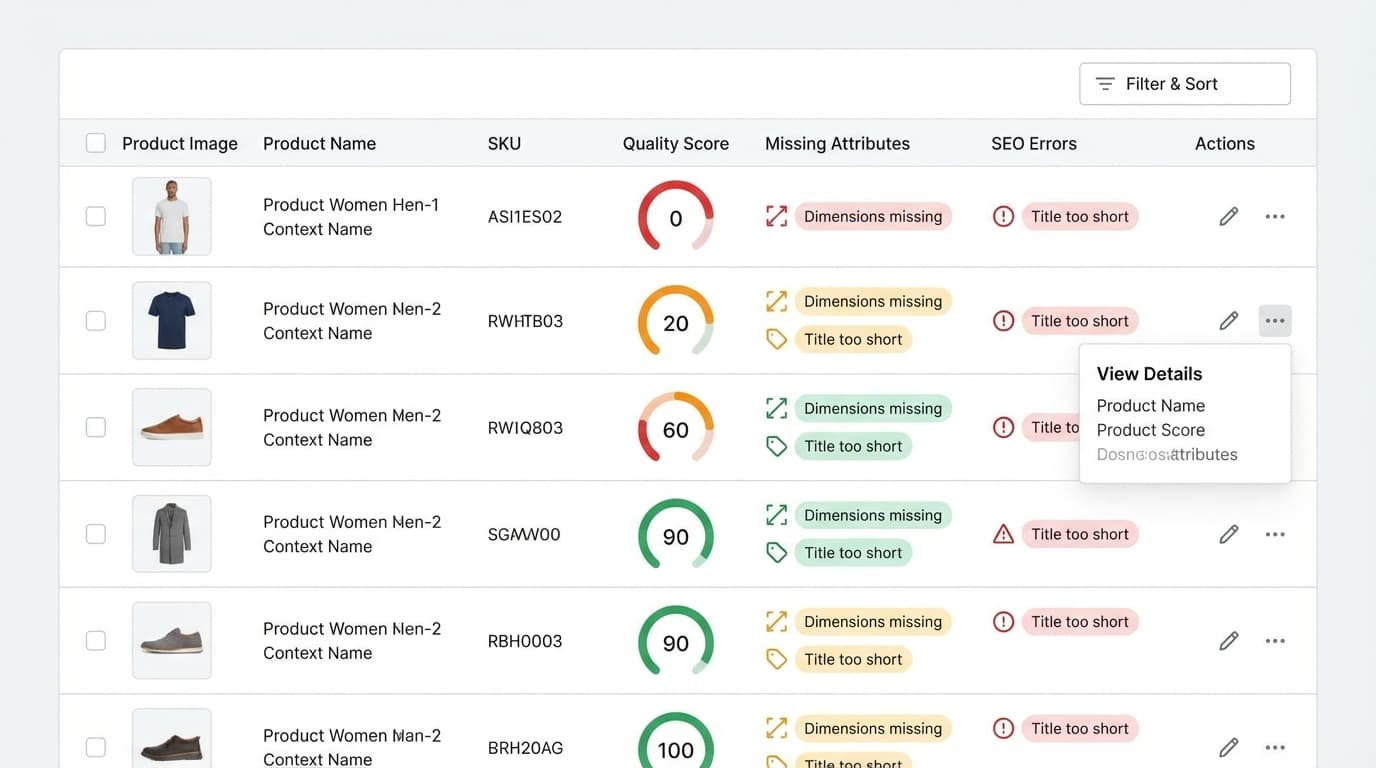
Automated SEO Audit Template (AI Logic):
Common error: Launching AI processes without a prior SEO audit template. Without clear style guidelines and business rules, AI can generate content by hallucinating data or losing the brand tone.
At ButterflAI, we automate the diagnosis and correction of your catalog using AI, allowing your team to move from manual editing to the strategic supervision of thousands of products in seconds. Our technology analyzes your listings' quality in real-time and executes bulk optimizations that directly impact your SEO and conversion.
Quick answers to common questions.
A practical QA scorecard and weekly workflow to prevent Merchant Center disapprovals, optimize your product data, and scale catalog growth.
Mar 4, 2026

Discover how to measure data quality in your ecommerce catalog using the 6 core dimensions, channel-specific scorecards, and continuous remediation loops.
Feb 26, 2026

Stop guessing with basic Etsy SEO tips. Map your catalog data to Etsy attributes, automate descriptions, and scale your listing optimization strategy systematically.
Feb 25, 2026