The Amazon Listing Data Model: What Actually Drives Conversion
Amazon listing optimization at scale starts by mapping each internal product attribute to the exact Amazon field that influences indexing and conversion. This section breaks down which fields matter, how they interact with Amazon indexing, and why correct parent-child variation relationships are critical to avoid visibility drops.
TL;DR: The Fundamentals
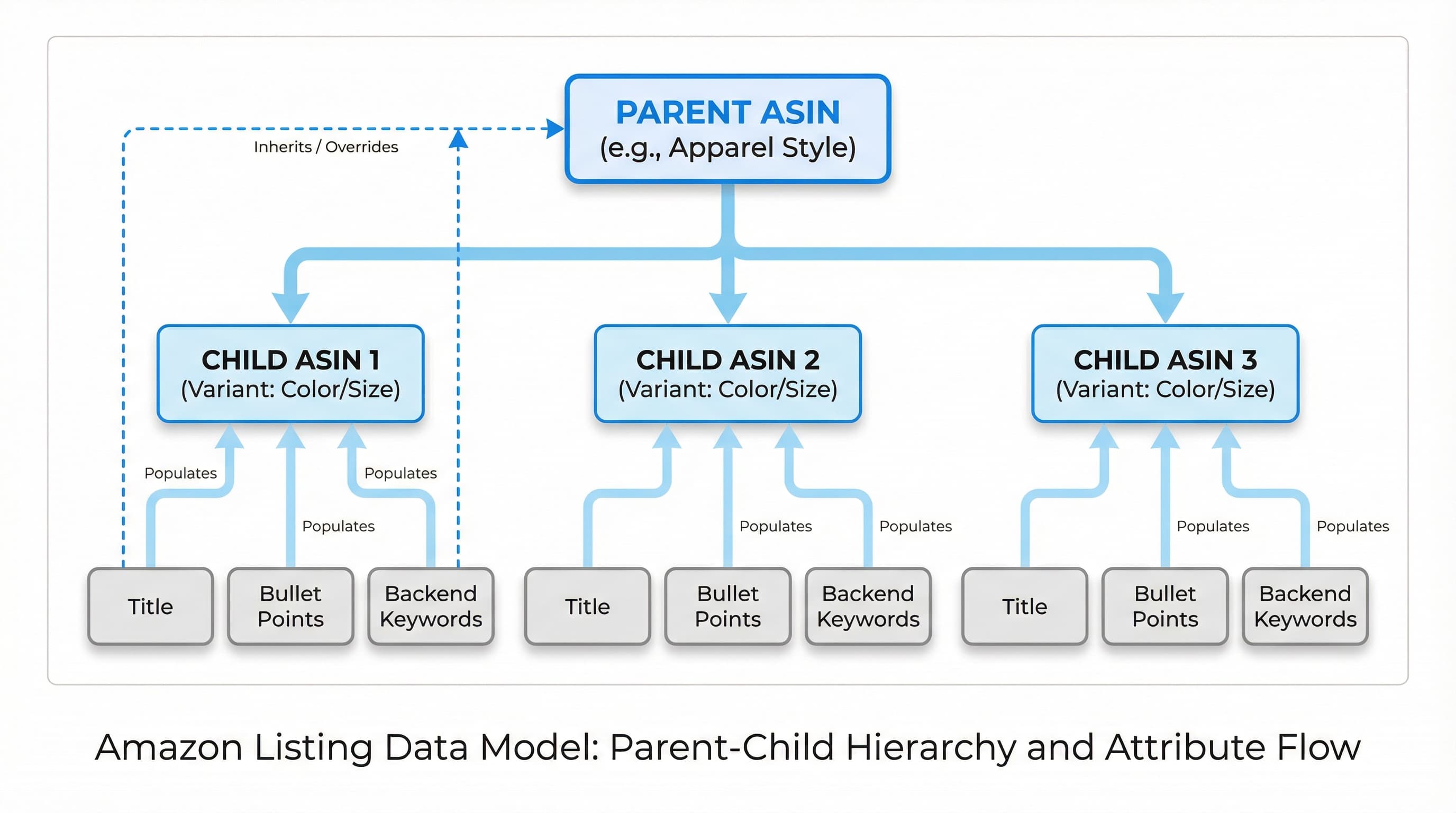
Product title and bullet points are your primary on-page relevance signals for indexing and click-through. Backend search terms add indexable vocabulary not visible to shoppers. Parent-child variation families must use allowed variation themes so children do not get suppressed or lose independent indexing. For implementation patterns and variation templates, see a practical guide by Seller Candy.
Title
Why this matters: The title is the strongest single-page relevance signal Amazon uses for both indexing and user click decisions.
How to approach: Build titles from canonical attributes using a template that places brand, model, key feature, size, and use in predictable slots. Enforce category length limits and avoid keyword stuffing by de-dupe rules at generation time. Use the title attribute from your PIM or master catalog as the source of truth so titles are repeatable across thousands of SKUs.
- Example: Brand + Model + Key feature + Size
- Typical error: Overfitting titles with every keyword token from research data, which causes truncation and poor readability.
Bullet points
Why this matters: Bullets convert technical attributes into buyer-focused benefits and support additional indexable terms.
How to approach: Map three to five priority attributes from your product data model into benefit-oriented bullets. Use structured fields for materials, dimensions, and compatibility so copy generation remains deterministic. Keep bullets scannable and aligned with the title to avoid internal keyword cannibalization.
- Example: Compatible with [Model X], Battery life 12 hours, Water resistant to 10 meters.
- Typical error: Copying full spec sheets instead of focusing on buyer intent.
Backend search terms
Why this matters: Backend search terms expand searchable vocabulary without harming conversion copy visible on the product page.
How to approach: Apply tokenization and de-duplication rules that remove words already present in title and bullets, include long-tail synonyms and alternate spellings, and respect character limits. Avoid punctuation and prohibited phrases. Treat backend fields as scarce index space that must be optimized per SKU using your catalog taxonomy and keyword research.
- Example: Include alternative spellings and long-tail phrases.
- Typical error: Repeating the same tokens across multiple backend fields causing wasted index space. For best practices and category limits, review Amazon documentation and practical guides such as this variation and indexing overview.
Parent-child variations
Why this matters: Correct parent-child relationships consolidate reviews and enable variant-specific indexing while preventing suppression or visibility loss.
How to approach: Use the correct variation theme allowed by category and create a non-purchasable parent record that acts as the anchor. Attach child SKUs that differ only in the allowed attributes. Validate brand and product type consistency across all children in your catalog export or flat file to avoid forced merges or delistings.
- Example: Color or Size variation family where only color or size differ.
- Typical error: Grouping unrelated products under one parent which triggers suppression and lost visibility.
Quick QA checklist
- Map canonical attributes to each Amazon field from your master catalog.
- Validate title template length per category.
- De-duplicate backend tokens and check field limits.
- Verify variation theme allowed for category and brand consistency.
- Run automated checks for missing images and mismatched product type.
The Scale Workflow: Mapping Your Catalog to Amazon Fields
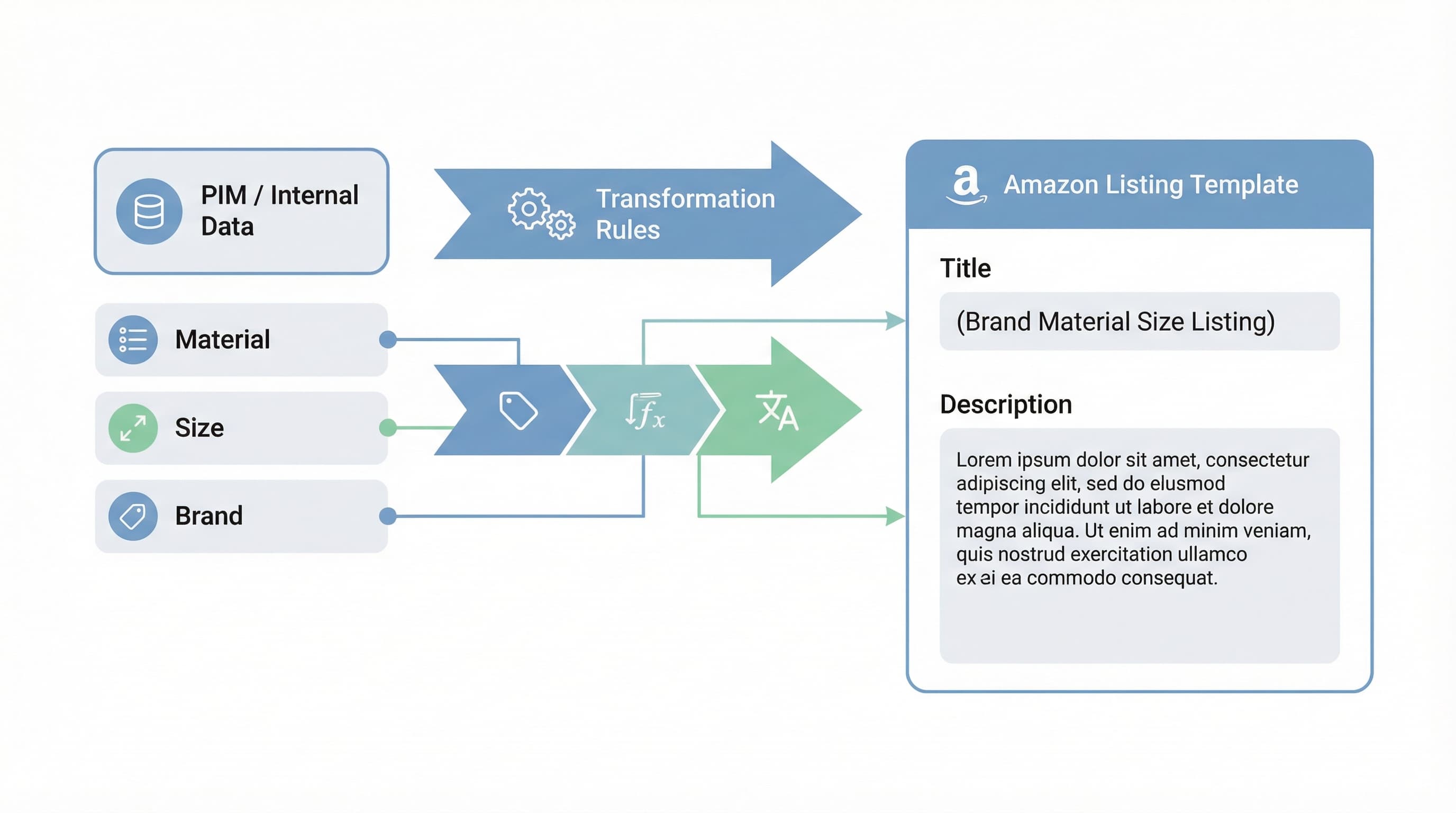
Amazon listing optimization starts with a deterministic map from internal product attributes to Amazon fields. This field-by-field blueprint explains how to build a source-of-truth attribute dictionary and an Amazon product listing template that powers automated generation, batch exports, and QA for thousands of SKUs.
Why this matters
Manual updates do not scale and cause inconsistent titles, bullets, and backend keywords across the catalog. A structured mapping enforces brand rules, prevents data drift, and unlocks automation for listing optimization, content operations, and catalog mapping. Consult Amazon rules and a practical feed automation example.
Build the attribute dictionary
A shared attribute dictionary is the single source of truth.
- How to do it: Inventory PIM fields, normalize names, assign data types and allowed values, add explicit examples, and assign an owner for each attribute. Mark fields required by Amazon and note where enrichments are needed.
- Example: Internal
sku_color maps to Amazon color_name (type: string, allowed values: red, blue, black).
- Typical error: Ambiguous attributes without examples that break transformations.
Define the Amazon template
A template controls what fills title, bullets, description, images, and backend keywords.
- How to do it: List each Amazon field and map the PIM attribute or transformation that will fill it. Include character limits, forbidden terms, and required image counts. Make templates machine-readable for feed exports and API integration.
- Example: Title =
Brand + Model + Key Feature + Size (Target max: 200 characters).
- Typical error: Concatenating tokens without enforcing length or forbidden term rules.
Raw attributes need normalization and SEO enrichment.
- How to do it: Define capitalization rules, unit conversions, synonym sets for backend keywords, and priority order for overlapping attributes. Add enrichment sources for long-form copy and keyword lists.
- Example: If
material = "metal" and finish exists, create combined "material finish" token for title generation.
- Typical error: Trimming variant indicators that reduce discoverability.
Implement batch export and QA scorecard
Export automation must be paired with automated QA.
- How to do it: Export a CSV or API feed using the template, then run a QA scorecard that validates required fields, length limits, image count, variation structure, and keyword coverage. Scorecards should output actionable failures per SKU.
- Example checklist: Title present, bullets (3-5), at least three images, backend keywords populated.
- Typical error: Pushing batches without running the post-export checks.
Rollout checklist
- Inventory attributes and assign owners.
- Create mapping table with transformation rules.
- Define SEO rules for title, bullets, and backend keywords.
- Run a 100-SKU pilot and iterate before scaling.
- Automate exports and apply QA scorecard to batches.
Tools and next steps: Use your PIM or a feed tool to manage mappings and automate exports. Start with a pilot and measure listing quality with the scorecard before scaling to thousands.
Batch Generation: Rules, AI, and Segmentation
Amazon listing optimization at scale requires field-level formulas that map canonical attributes into titles, bullets, image instructions, variation rules, and backend keywords. This section shows a practical way to build category-specific rules, where AI is used for style harmonization and deduplication but not for business logic.
Quick TL;DR
Segment by category and conversion band. Define short templates per field with slots and hard limits. Add conditional rules for variations and safety content. Use an automated QA scorecard before pushing to Seller Central. For official constraints, check Amazon product title guidance.
Mapping attributes to templates turns manual writing into repeatable output and reduces policy risk.
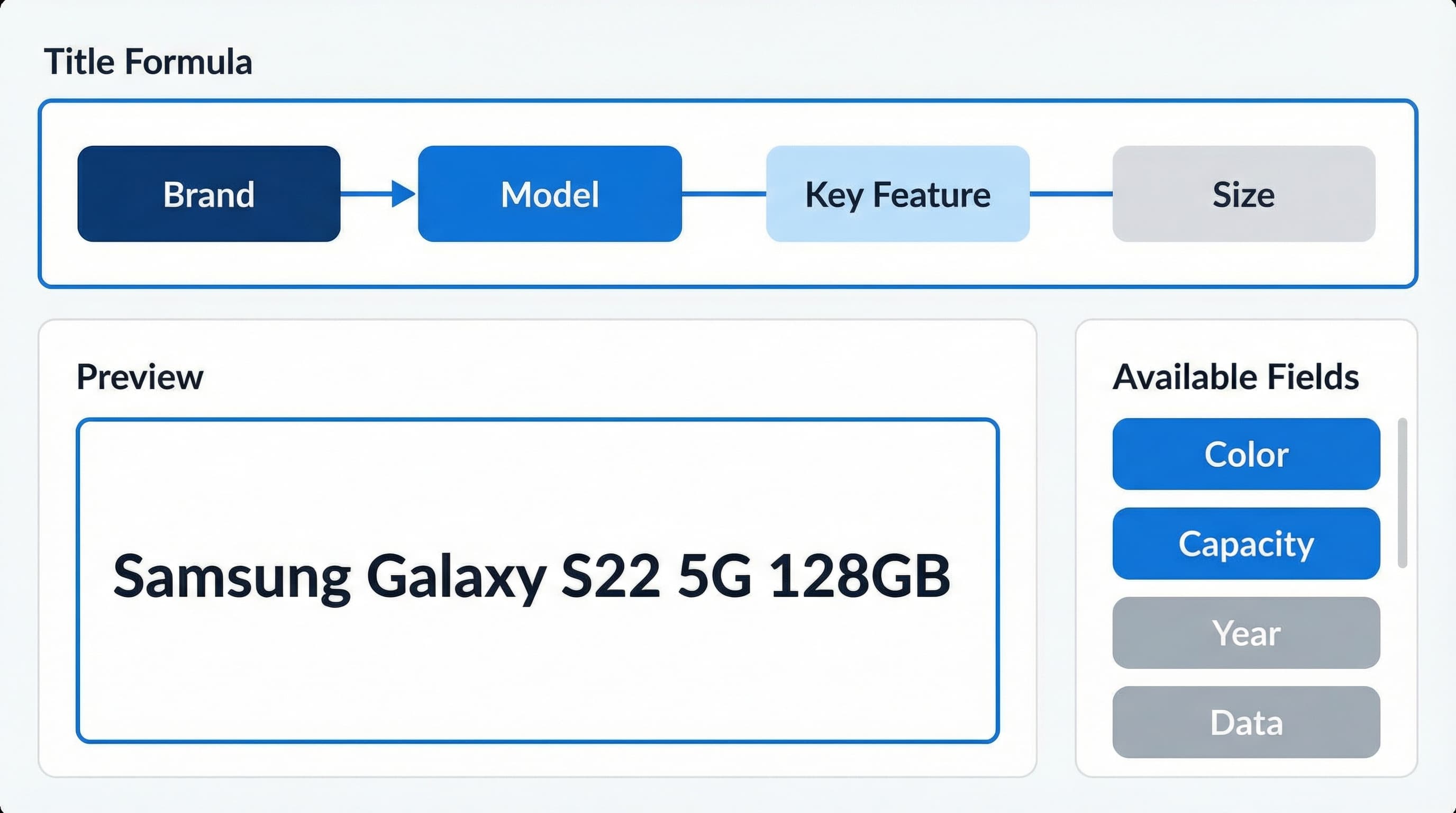
Create a template per category that defines slot order and priorities.
- Example template for small appliances:
Brand + Model + KeyFeature + Wattage + Color.
Use your PIM to provide normalized values. PIM is a product information management system used to store canonical attributes for each SKU. See a PIM primer for integration notes.
A single focused rule prevents length and policy violations.
Write a title pattern with mandatory and optional slots and a strict character cap. Add conditional rules so model or size only appear when present.
- Example pattern:
Brand + Model + KeyFeature + Size.
- Typical error: Overloading titles with irrelevant keywords.
Bullet templates and priority rules
Bullets are skimmable and must follow a predictable order for conversion.
Set bullet slots for primary benefit, usage, materials, care, and compliance. Limit each bullet to a max length and ban promotional qualifiers.
- Example: Bullet 1 = Primary Benefit + Use Case.
- Typical error: Repeating the same claim across bullets.
QA scorecard and governance
Automated checks catch scale problems before publish.
Run validations for title length, forbidden terms, backend keyword length, duplicate content, and image set completeness. Keep a weekly manual sample audit to catch false positives.
- Example scorecard rows: Policy check, Readability score, Duplication flag.
Actionable checklist
- Segment catalog by category and conversion band.
- Draft title and bullet formulas per segment and document slot priority.
- Implement a rule engine with conditional slots and synonym normalization.
- Run bulk generation with an AI style pass and dedupe.
- Apply automated QA scorecard and manual sampling.
Amazon Listing Optimization at Scale: Listing Quality Score
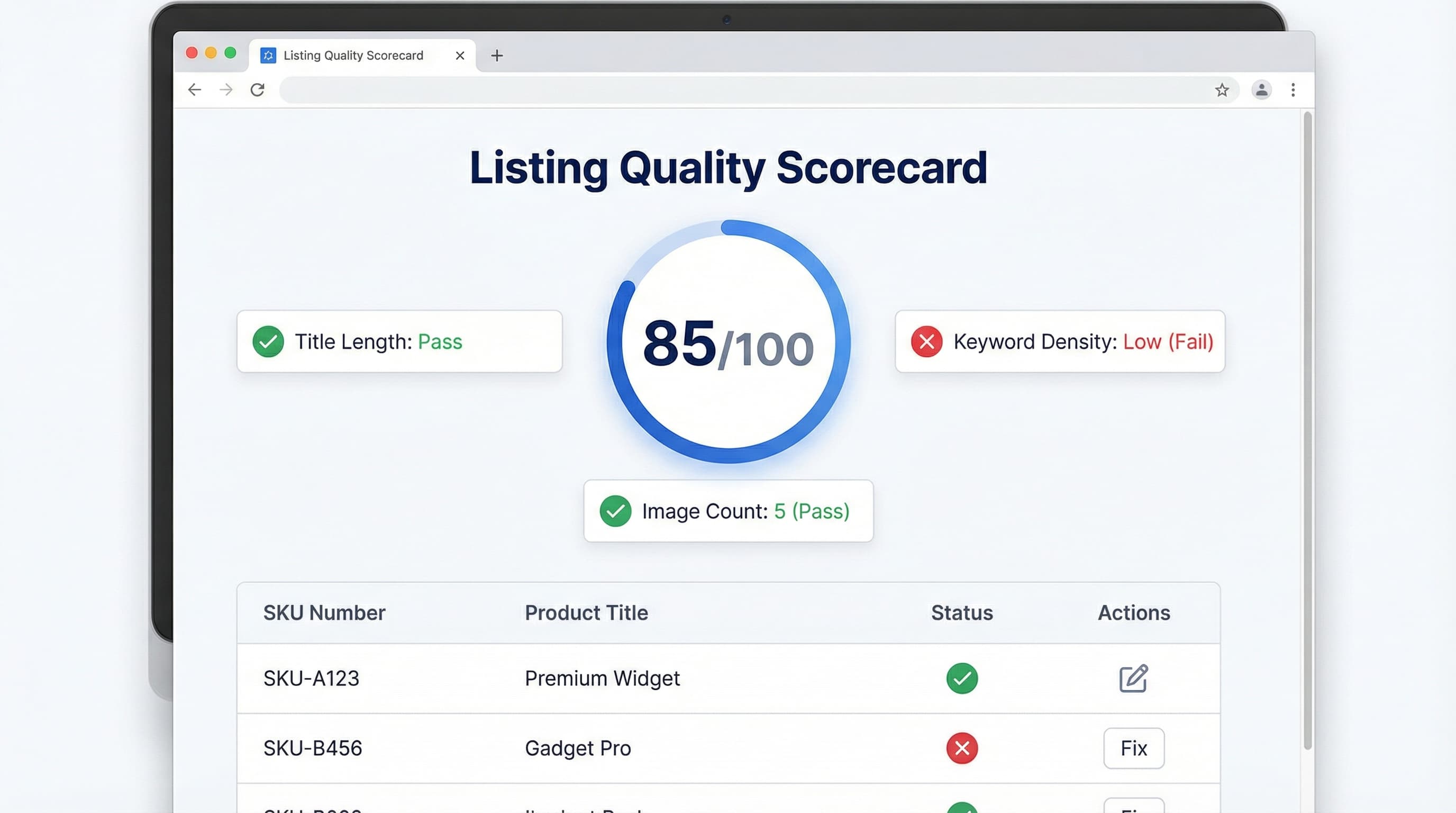
A Listing Quality Scorecard turns internal product attributes into a repeatable control that surfaces completeness gaps, compliance risk, and indexing hygiene across thousands of Amazon SKUs.
Context: PIM means product information management, centralizing product attributes for feeds. Seller Central is the compliance portal where updates are published.
The goal is a numeric Listing Quality Score that teams can filter and action across thousands of SKUs. Metrics drive prioritization and automation.
Sampling plan
This defines representative checks so audits reveal systemic issues rather than lucky passes. Apply a stratified random sample by category, supplier, and lifecycle stage. Store the sample logic in a BI view or PIM export so audits are reproducible.
- Example: 1 percent of SKUs per category or minimum 100 SKUs per category.
- Typical error: Sampling only top sellers.
Field completeness checks
Completeness prevents avoidable listing failures and lost conversion. Implement validation rules in the PIM or ETL pipeline and capture pass/fail per field into the LQS.
- Example rule: Title present and between 50 and 200 characters, minimum three bullets, main image plus required additional images.
- Typical error: Allowing free text for backend keywords without byte counting.
Compliance and policy checks
Policy failures cause delisting and account actions. Use taxonomy mapping and regex-driven flags to detect prohibited claims, restricted brands, and wrong categories. Route flagged items to a manual review queue and record reviewer decisions for rule tuning.
- Example: Flag unverified health claims for manual review.
- Typical error: Treating checks as static instead of updating after policy changes.
Indexing checks verify that backend and visible fields are actually indexed and do not exceed limits. Run batch indexing tests for top search terms per SKU using a keyword tool and store indexing pass rates in the LQS. Fix backend search terms and recheck. See backend keyword best practices for detail.
- Example: Detect missing indexing for three priority terms and push fixes.
- Typical error: Exceeding the 250-byte backend limit.
Quick checklist
- Define sample and pass thresholds.
- Automate field validation and capture failures into LQS.
- Run indexing audit with a keyword tool and store results.
- Triage and fix top five failure modes.
Continuous Optimization: Testing and Monitoring
Amazon listing optimization at scale requires a safe, repeatable feedback loop that turns wins into standards and flags regressions fast. This short field guide explains how to run controlled experiments, monitor suppressed ASINs, and use search term data to prioritize fixes so a catalog stays retail ready.
Run safe A/B tests
Controlled tests reveal which content fields move conversion without risking catalog health. Amazon Experiments is a Seller Central feature that runs controlled listing variants and compares customer response. It matters because it isolates the impact of one field change.
- How to: Limit tests to low-risk SKUs, run a single field change per test, split traffic, and run until statistical guidance is met. See a guide to Amazon experiments.
- Example: Run a title variant on 200 daily view SKUs for 14 days and compare conversion rate plus units sold.
- Error: Changing multiple fields at once makes results unusable.
Monitor suppressed ASINs and listing health
A suppressed ASIN stops buying activity quickly and is often fixable with a catalog-level rule.
- How to: Automate daily checks against marketplace health exports and classify suppression reasons into mapped fixes in your PIM. For common suppression types and remediation, see this suppression guide.
- Example: Map missing bullet points to an enrichment rule that copies
product_feature from product_description.
- Error: Repairing one SKU manually instead of updating the attribute source.
Search term trends show where content affects discoverability and SEO at scale.
- How to: Export search term reports, group by intent and volume, score terms by revenue potential, then generate title or backend keyword hypotheses and test them. Use a scoring matrix to turn search term signal into prioritized work for content operations and catalog mapping. For monitoring automation ideas, see Helium 10's guide.
Actionable checklist
- Select 100 high-traffic SKUs.
- Export search term report and filter by impressions.
- Score terms by intent and conversion potential.
- Create title or backend keyword hypotheses.
- Run single-field experiments and monitor weekly.
Automated Optimization with ButterflAI
Managing structured data, mapping attributes, and maintaining a high Listing Quality Score manually across thousands of SKUs is often the bottleneck that prevents growth. ButterflAI detects quality gaps and automates the generation and optimization of titles, descriptions, and backend keywords directly within your existing workflow.
ButterflAI connects to your catalog to enforce rules and leverage AI for scale, ensuring your listings remain compliant, indexed, and conversion-ready without the manual overhead.