What Is Data Quality Management in Ecommerce?
Product data quality is the practice of keeping product attributes accurate, complete, and usable across all sales channels. Messy titles, missing images, inconsistent attributes, and invalid identifiers cause failed feeds, lower search visibility, and extra manual work. Data quality management for ecommerce means setting measurable rules, monitoring catalog health, and running a weekly remediation loop so fixes compound over time.
To measure and operationalize this, you must first understand the core technical concepts that dictate how product data moves across an ecommerce ecosystem:
- Shopify metafields: Custom product fields in Shopify used to store structured data that power storefront templates and integrations.
- PIM (Product Information Management): A centralized system that stores, normalizes, and distributes product attributes to all sales channels.
- Feed: A structured file or API export used to send formatted product data to marketplaces and advertising platforms.
- Schema: A structured data model that defines attribute names, types, and validation rules so systems can correctly map data.
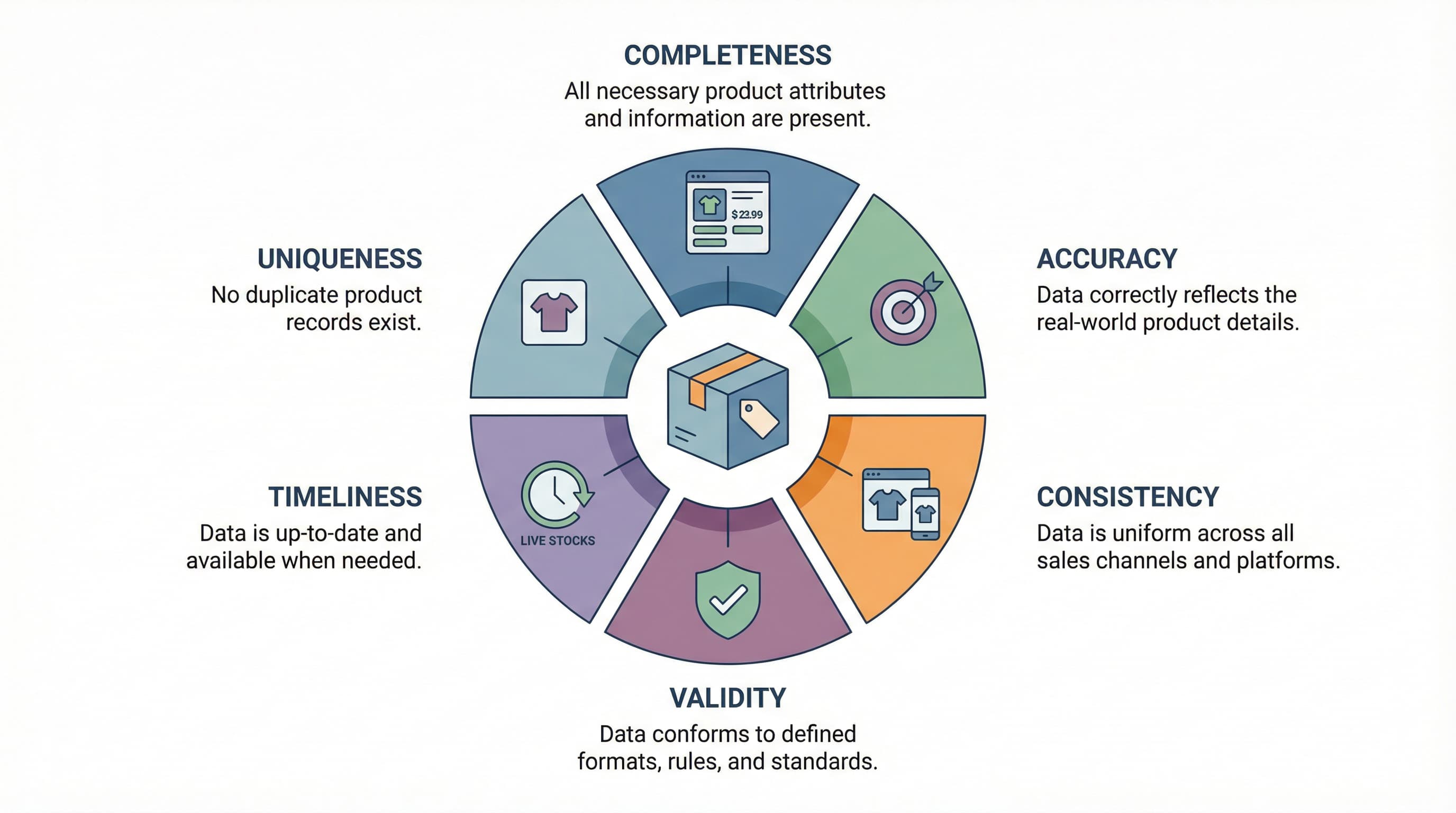
The 6 Core Dimensions of Product Data Quality
How to measure product data quality matters because clear, measurable dimensions let teams convert audits into weekly remediation work that moves KPIs. Score product records across six core dimensions and use channel-aware weights to reflect SEO, feeds, and marketplace priorities.
Completeness
Missing attributes stop listings from appearing in search and filters. Completeness directly impacts SEO visibility, frontend filters, and product feed approvals. Define required attributes per product type and channel, then automate presence checks and severity scoring.
- Example: A mattress missing dimensions will not surface in size filters.
- Typical error: Treating empty placeholder values as valid data.
Accuracy
Wrong values increase returns and harm the customer experience (CX). Accuracy reduces returns, protects margins, and preserves marketplace trust. Crosscheck supplier feeds and order history to establish a single source of truth, apply numeric validations for price and weight, and alert on discrepancies.
- Example: Incorrect voltage listed for an electronic appliance causes returns in specific markets.
- Typical error: Trusting manual edits without source verification.
Consistency
Inconsistent labels or units break filters and reporting. Consistency enables faceted navigation, consolidated SEO, and reliable analytics. Standardize attribute names, units, and taxonomy in a PIM or metafields layer.
- Example: Mixing "cm" and "centimeters" breaks numeric size filters on the frontend.
- Typical error: Allowing free-text inputs for controlled attributes like color or size.
Validity
Invalid formats block feed ingestion and approvals. Validity prevents feed rejections and channel disapprovals by enforcing strict format rules. Enforce regex and schema checks for GTIN, SKU, and image URLs, validating against each channel template.
- Example: A Google feed is rejected due to a wrong GTIN format.
- Typical error: Accepting human-readable values that fail machine validation.
Timeliness
Outdated price or stock damages conversion and raises cancellations. Timeliness avoids wrong price or stock-related cancellations and a poor customer experience. Configure sync cadences and SLAs for price, availability, and promotions; monitor feed latency and rejection trends.
- Example: A sale price is not updated fast enough during a flash promotion.
- Typical error: Relying only on a nightly sync for fast-moving SKUs.
Uniqueness
Duplicates split SEO and increase operational cost. Uniqueness prevents duplicate listings, catalog bloat, and split SEO signals. Detect duplicates by title, GTIN, and SKU, then merge or deprecate them, keeping master records in a PIM.
- Example: Multiple similar listings compete against each other in marketplace search.
- Typical error: Creating entirely new product records for small variants instead of mapping them properly as variants.
Checklist to Operationalize These Dimensions
- Define required attributes by channel and product type.
- Implement automated validation rules and regex checks.
- Set sync cadence and SLAs for critical fields.
- Run a weekly scorecard and remediation loop with owners.
- Deduplicate and enforce master records in the PIM.
How Product Data Quality Standards Impact Revenue
Product data quality sits at the intersection of discoverability and conversion. When critical attributes such as variants, materials, shipping dimensions, and global identifiers are missing or inconsistent, product detail pages (PDPs) lose organic visibility and product feeds get disapproved or misrouted, which directly reduces revenue. Product data quality must be measured with channel intent in mind, not with one-size-fits-all rules.
Why Generic Standards Fail
Generic data standards treat completeness as a single metric. Ecommerce needs attribute-level rules that reflect listing logic and channel validation. For example, missing variant SKU mapping harms stock-based listings and marketplace matching. Missing material or care instructions harms PDP SEO. Missing shipping weight or dimensions causes shipping cost mismatches in feeds and cart abandonment.
| Dimension | Generic Standard | Ecommerce-Specific Rule | Channel Intent |
|---|
| Completeness | X fields present | Variant SKU present per option and main image per variant | Feeds and marketplaces need variants to match listings |
| Identifiers | Optional global id | GTIN and brand required when available | Marketplaces and shopping engines use this to deduplicate |
| Attributes | Basic title and description | Materials, care, shipping weight, and dimensions | PDP SEO and accurate shipping calculations |
| Consistency | Field values present but not validated | Uniform units for weight and dimensions and consistent color naming | Feeds expect normalized units and marketplaces match by attributes |
- Run channel scorecards and flag top 200 low-quality SKUs by revenue exposure and feed risk.
- Prioritize fixes by revenue exposure category and feed rejection risk.
- Patch canonical data in the PIM or Shopify metafields and re-export the product feed.
- Validate changes with feed diagnostics and search rich result testing tools.
- Report weekly trends to stakeholders and update rules and weights.
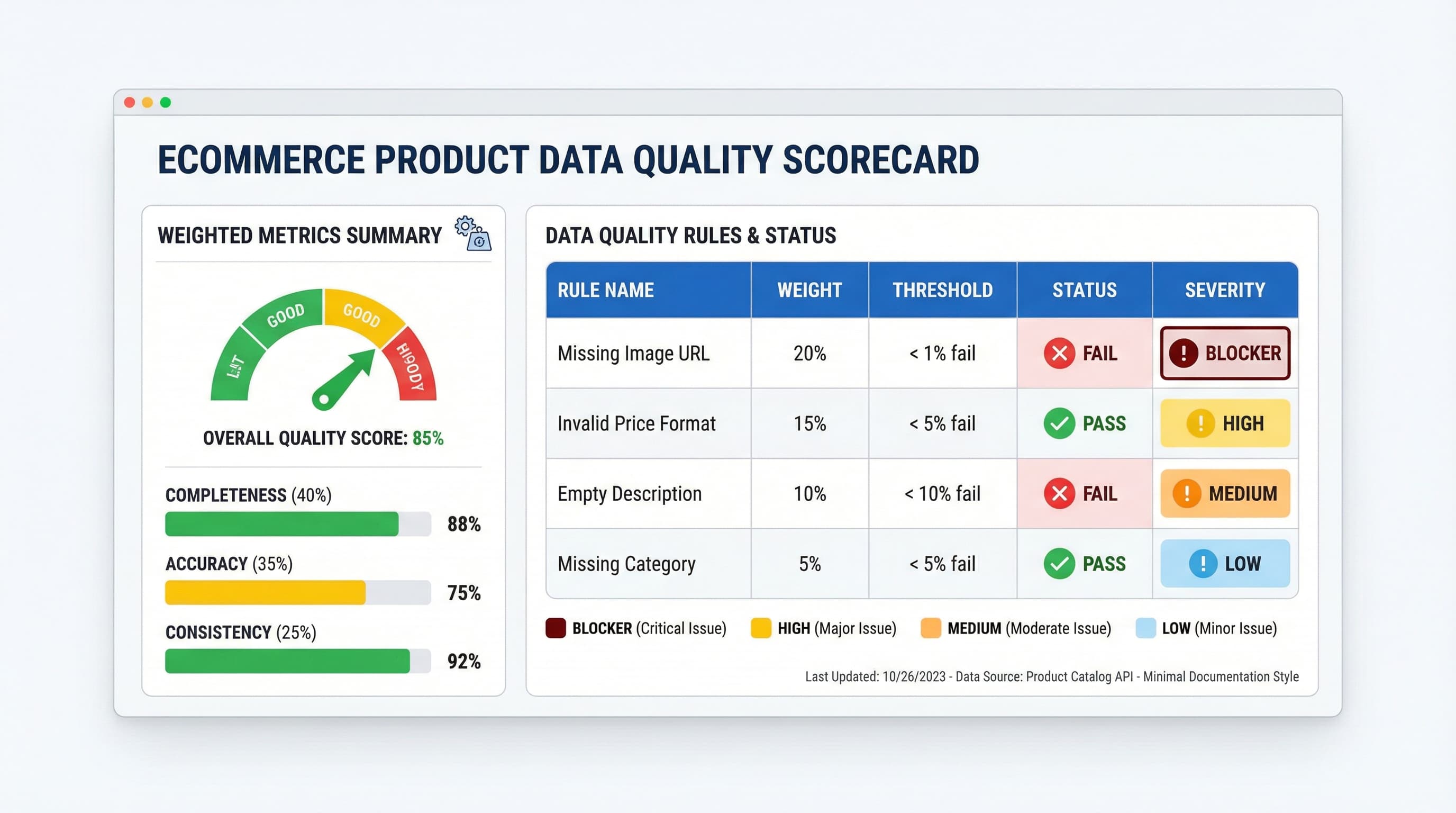
Build a Product Data Quality Scorecard
Measuring product data quality starts with a simple scorecard that turns rules into binary checks and weighted metrics. The scorecard makes product data quality measurable and repeatable, aligning catalog teams on what to fix first. Follow this step-by-step to build a practical scorecard and a weekly remediation loop that reduces blocked listings and improves SEO and feed performance:
- Define rule types and priorities.
- Map weights per channel based on intent.
- Set thresholds for blocker, high, and medium severity.
- Automate checks in your PIM or feed pipeline.
- Run a weekly remediation sprint and track trend lines.
Required Fields
- Why it matters: Required fields prevent blocked listings and bad search performance.
- How to approach: List the minimal set per channel (e.g., title, description, price, image link, brand, GTIN).
- Example:
title must be non-empty and between 50 and 150 characters.
- Typical error: Publishing a product with a missing main image or empty brand field.
Allowed Values and Controlled Vocabularies
- Why it matters: Controlled vocabularies enable taxonomy mapping, clean filters, and consistent facets.
- How to approach: Define canonical lists for fields like condition, availability, gender, and category. Store those lists in the PIM or mapping logic and forbid free text.
- Example:
availability must be exactly one of: in stock, out of stock, preorder.
- Typical error: Free-text values break category mapping and faceted search.
- Why it matters: Correct formats avoid feed rejections and data parsing errors.
- How to approach: Use regular expressions to validate price, numeric formats, SKU patterns, GTIN digit counts, and URL structure. Validate at the source or during feed export. For feed specifications, consult the Google Merchant Center product data specification.
- Example:
price must match digits followed by a dot and two decimals.
- Typical error: Currency symbols included directly in numeric fields causing feed parsing rejections.
Cross-Field Logic and Business Rules
- Why it matters: Cross-checks find logical mistakes that single-field rules miss.
- How to approach: Implement rules such as sale price being less than regular price, inventory consistent with availability, and country-level shipping constraints. Use ETL or PIM rule engines to evaluate.
- Example: When
sale_price exists, it must be strictly lower than price.
- Typical error: Sale price equal to or higher than the regular price, causing marketplace policy flags.
Weighting by Channel and Thresholds
Map each rule to a channel impact score. Google Shopping prioritizes price, GTIN, and images, while marketplaces reward brand, category, and condition. Weight rules for each channel, compute a composite product score, and enforce thresholds:
- < 40% (Blocker): Do not publish.
- 40% - 70% (High): High priority fix in the next sprint.
- 70% - 90% (Medium): Acceptable, monitor for improvements.
- > 90%: Publishable and healthy catalog item.
Adjust weights based on actual conversion and rejection rates. Monitor trends with weekly reports and store links to failing SKUs directly in your ticketing system.
Product data quality is the backbone of discoverability and conversion. This section gives a practical weekly governance loop that turns a scorecard into continuous improvement, plus ownership rules and bulk remediation paths you can operationalize with a PIM export, AI-assisted enrichment, and a human QA gate. This ties catalog management, product feeds, content operations, and marketplace readiness into a continuous cadence.
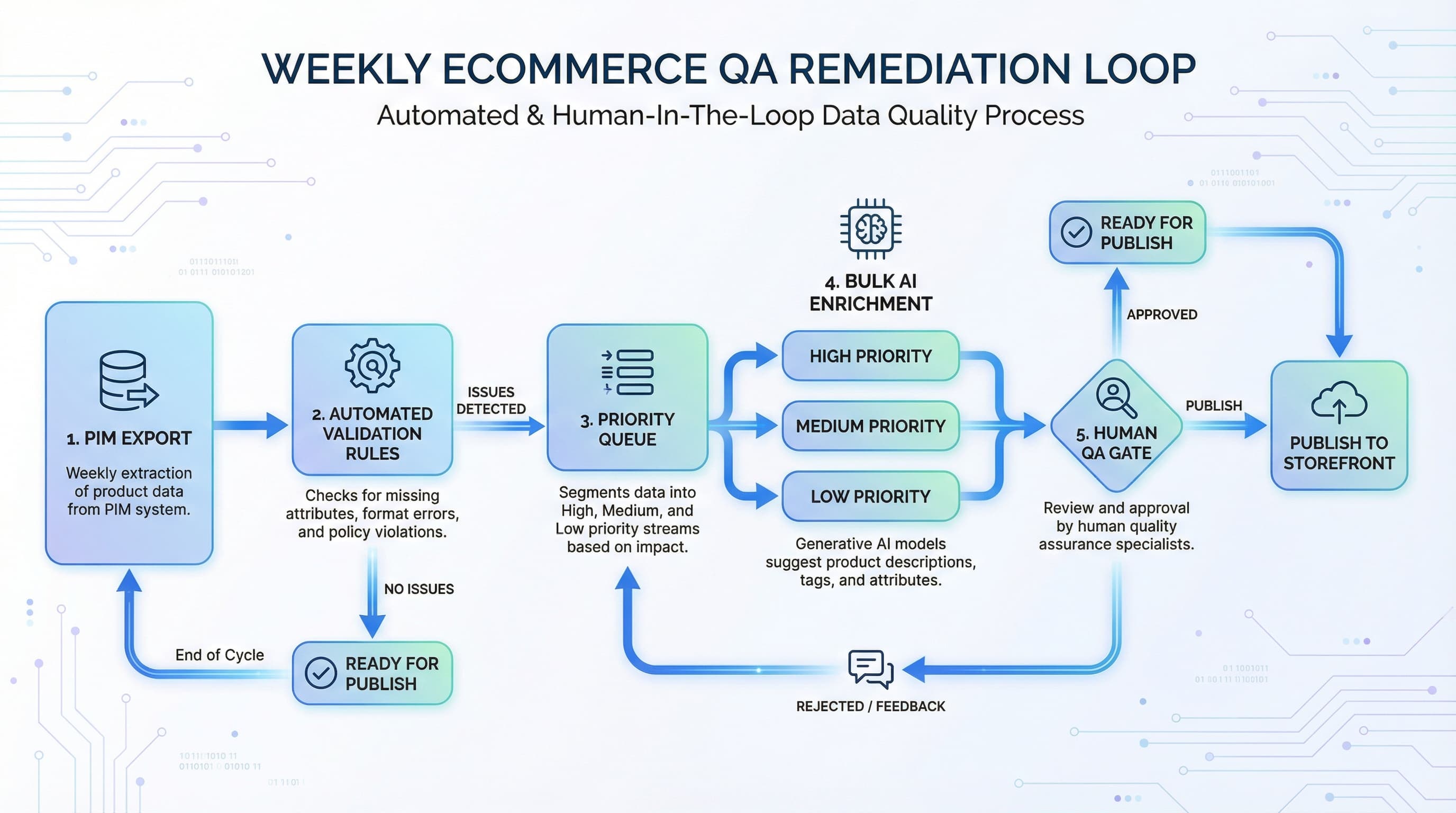
Step 1: Define Channel Scorecards and Owners
Channels require different fields and quality thresholds. Map rules from your master scorecard to channel requirements. Set numeric thresholds and assign an owner type for each rule.
- Data Steward: Handles schema consistency, GTINs, and attribute validation.
- Merchandiser: Owns SEO titles, descriptions, and category mapping.
- Example: Assign title length and bullets to the merchandising owner and GTIN validation to the data steward.
- Typical error: Unclear ownership leading to repeat failures.
Step 2: Weekly QA Loop Checklist
Ritualized checks convert insight into action. Run automated validations from a PIM export, then surface the top failures ranked by business impact. Use a ticketing board for the week and schedule a 30-minute triage between the steward and the merchandiser.
- Export the latest feed from the PIM for the target channel.
- Run scorecard validations and generate prioritized failures.
- Convert top failures into bulk remediation batches.
- Assign batches to a remediation tool or human editor.
- Reimport and run quick QA on a sample set.
Manual edits do not scale for catalogs with thousands of SKUs. Use the PIM export as the canonical change file. Apply normalization dictionaries for brand names, attributes, and categories. Run AI-assisted enrichment to generate missing descriptions, bullets, and attribute values, then pass results through a human QA queue.
- Example: Normalize vendor names with a dictionary, then enrich missing descriptions in batch, and QA a five percent sample.
- Typical error: Skipping normalization, leading to duplicate remediation work and fragmented reporting.
Ecommerce Catalog Quality Assurance Checklist
Product data quality must be measurable and actionable if you want continuous improvement rather than one-off audits. Use a prioritization matrix that combines revenue or traffic exposure, defect severity, and fix effort to produce a ranked remediation backlog and weekly remediation loop.
Checklist Matrix and Scoring
- Map revenue or traffic exposure per SKU and assign an impact score from 1 to 5.
- Classify defects as critical, major, minor, and estimate fix effort in hours.
- Score each SKU using:
(Impact × Severity) / Effort to rank work without manual bias.
- Create automated checks for completeness, consistency, validity, accuracy, and uniqueness and export exception lists to your tasking tool.
Error Budgets and SLAs
- Set an error budget per vendor or category as the permitted percent of defective SKUs per week and reduce it month-on-month until trendlines stabilize.
- Report weekly trendlines with a median score per category, top 20 exceptions, and a simple control chart to spot regressions.
- Define a quality SLA per vendor or category for time to remediate and an escalation path for repeat offenders.
- Map high-priority cases from the matrix.
- Create tickets and assign owners.
- Apply automated fixes or manual corrections.
- Verify fixes, close tickets, and update trendlines.
For structural advice on storing enriched data natively, review the Shopify metafields documentation.
Solving Catalog Data Quality at Scale
Maintaining strict completeness and consistency rules across thousands of SKUs manually drains team bandwidth and delays time-to-market. ButterflAI detects product data gaps and applies rule-based normalization and AI-assisted enrichment at scale, ensuring your catalog continuously meets channel standards without the manual overhead.