What Digital Shelf Analytics Is (and Isn't) for Ecommerce Teams
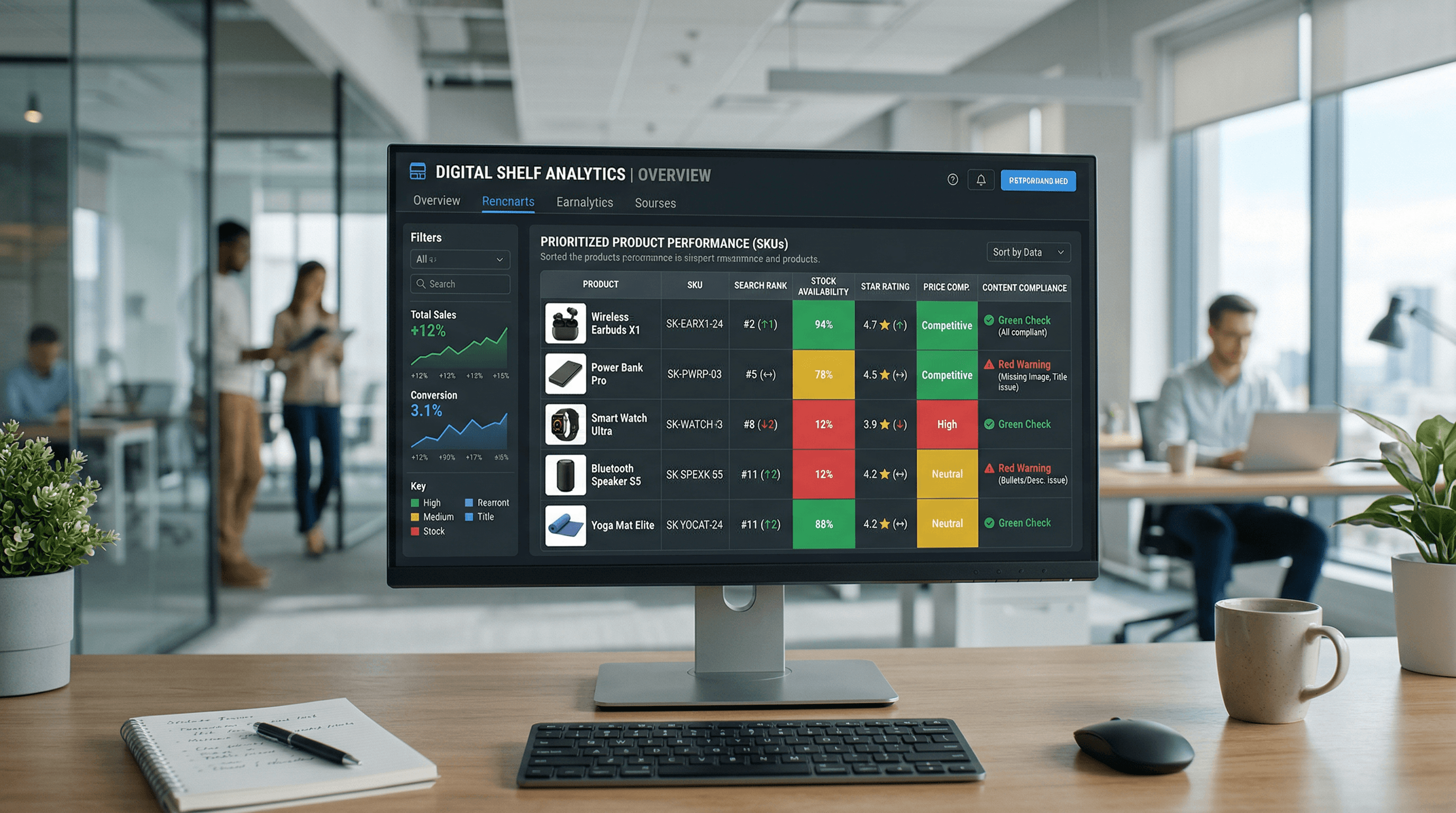
Digital shelf analytics is the ops practice of turning retailer shelf signals—such as search rank, product content compliance, availability, reviews, and price—into a prioritized weekly backlog for catalog teams. It focuses strictly on SKU-level discoverability and competitive presence on retailer pages and marketplaces, rather than top-of-funnel on-site traffic metrics.
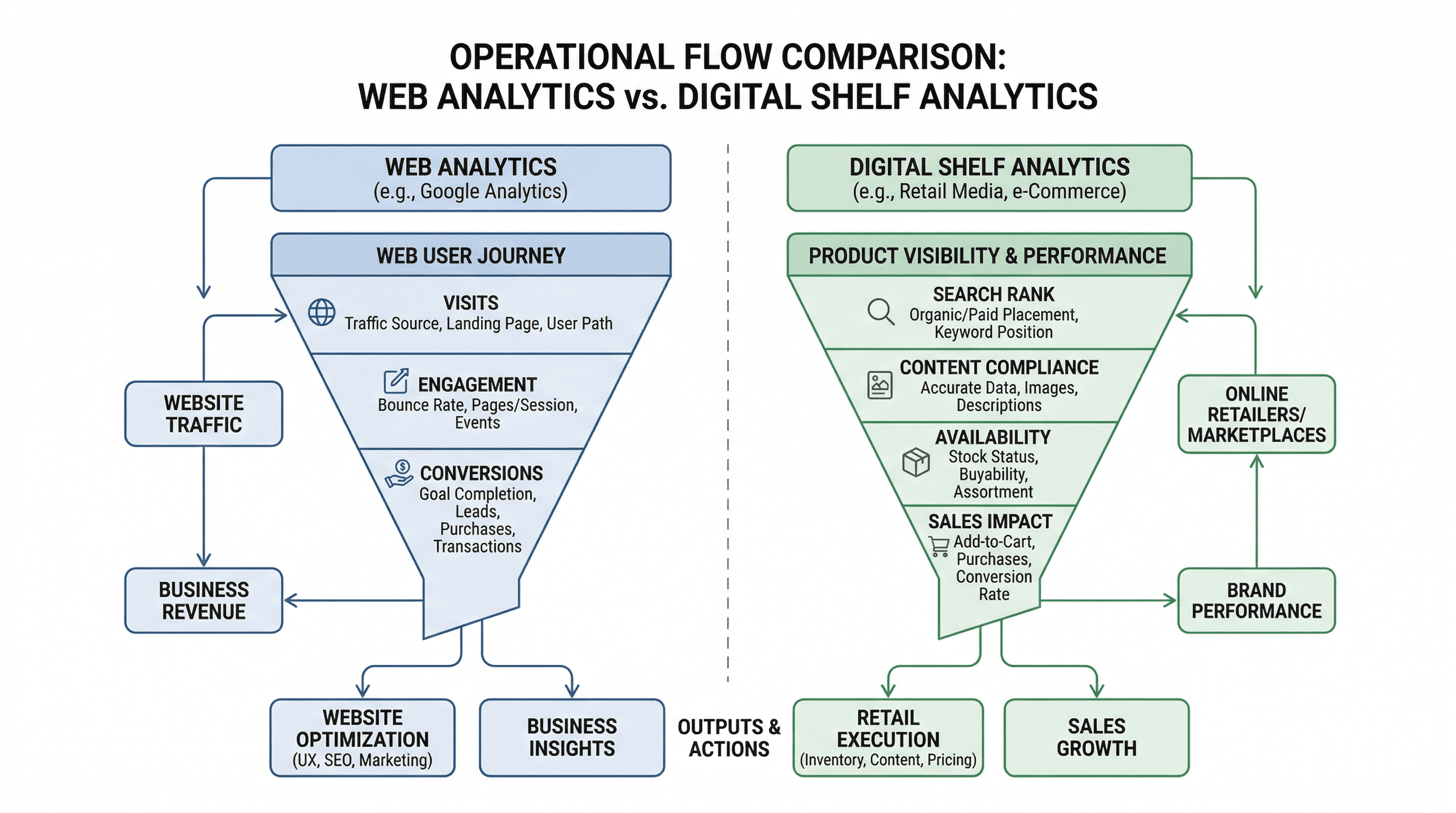
How digital shelf metrics differ from web analytics
Web analytics measures visits, conversions, and user journeys on owned sites. Digital shelf analytics measures product signals directly on retailer channels and links those signals to business impact, such as lost share of search ecommerce or missed buy box opportunities. Implementation requires retail-native metrics. You can reference understanding digital shelf positioning for a vendor perspective on these signals.
Why this matters for ops teams: Operationalizing the digital shelf means converting raw signals into tactical fixes that recover revenue. Raw scraping output is not enough. Teams that prioritize exotic marketing experiments before stabilizing fundamental product assets waste time.
Technical context:
- PIM is a Product Information Management system that centralizes master product data for omnichannel syndication.
- Shopify metafields are typed, custom fields that store extra product attributes needed for API distribution and front-end display.
Quick checklist to build a weekly digital shelf sprint
- Collect signals by retailer and SKU, tracking retail search ranking, content completeness, price, and stock levels.
- Score each detected issue by estimated revenue impact and ease of fix.
- Build a top 20 SKU backlog for the current week.
- Assign clear owners and due dates within the operations tracker.
- Remediate missing attributes via PIM and verify changes propagate to retailer pages.
Choosing Retailers and Marketplaces to Monitor
Digital shelf analytics must start by matching the channel scope to actual business impact. Prioritize sites driving the most revenue so teams can turn shelf signals into a meaningful product data backlog without alert noise. Start with owned direct-to-consumer (D2C) sites, move to core marketplaces, and finally incorporate strategic retail partners.
Digital shelf channel scope comparison
| Channel Type | Why Monitor This Channel | Primary Measurement Method | Key Signals to Prioritize | Recommended Cadence |
|---|
| D2C Site | Direct revenue and full conversion control | Internal search rank, conversion rate, page views | Missing attributes, out of stock monitoring, low site search rank | Weekly |
| Third-Party Marketplace | High discoverability and transaction volume | Marketplace search rank, buy box presence | Product content compliance, buy box ownership, review velocity | Weekly to Biweekly |
| Retail Partner Site | Strategic distribution and pricing reach | Feed error logs, listing compliance, availability | Feed mismatches, price deviations, OOS alerts | Biweekly |
Checklist to scope tracking and prioritization
- Select the top three channels based on revenue contribution.
- Map required signals per channel and assign a single owner for each.
- Integrate product feeds or APIs to enable automated checks.
- Technical note: A feed is a structured data export used to continuously update product listings across various retail channels.
- Define weekly sprint rules covering issue severity and expected resolution timeframes.
- Execute a 30-SKU pilot program to validate your scoring model before scaling.
Common operational error: Do not attempt to monitor every channel simultaneously, and avoid treating all shelf signals equally.
Building Your Digital Shelf KPI Tree
Start with a compact KPI tree flowing from visibility to conversion to profitability. Operations teams should use this map as the decision matrix for the weekly product data backlog, ensuring fixes for the highest-impact SKUs are prioritized.
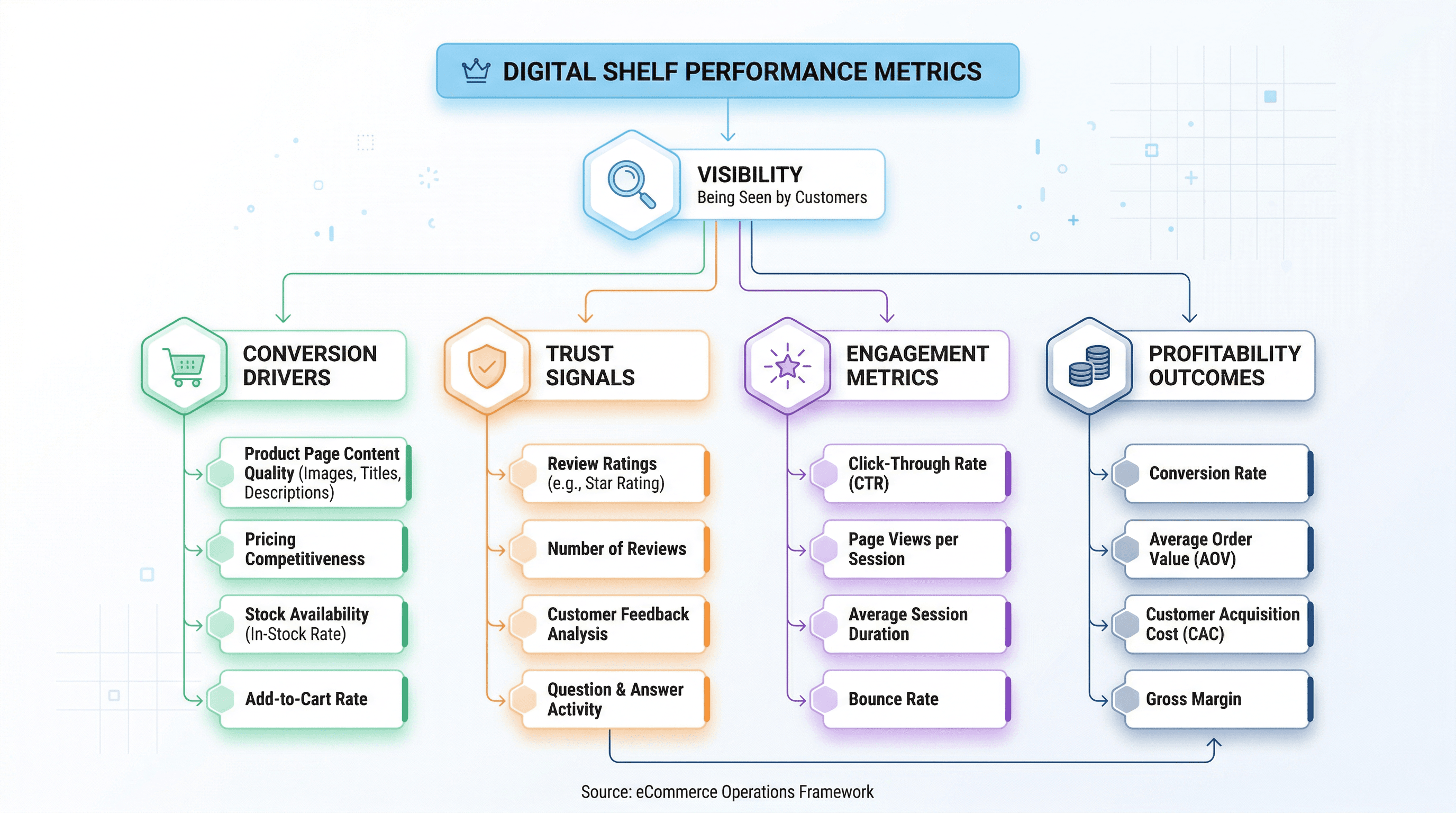
The visibility to profitability flow
KPI Layers Breakdown:
- Visibility
- Share of search for target priority keywords.
- Retail search ranking and real-time availability.
- Conversion Drivers
- Product content compliance across titles, bullet points, and primary images.
- Attribute completeness and schema accuracy.
- Technical note: Schema is a structured data framework that standardizes how attributes are mapped to meet search engine or marketplace requirements.
- Rating averages and review velocity that directly affect conversion rates.
- Trust Signals
- Verified review presence and active Q&A participation.
- Return rates and seller scores.
- Profitability
- Units sold and profit margin per SKU.
- Net revenue after accounting for promotions and returns.
Baseline setup checklist for the KPI tree
- Conduct a 7-day automated crawl for your top 100 SKUs, capturing search rank and availability data.
- Validate titles, bullet points, images, and primary attributes.
- Check all attribute mappings against the PIM or feed schema and fix misalignments.
- Flag SKUs experiencing a sudden drop in review velocity or an uptick in return rates.
- Generate a weekly prioritized backlog, sorted by estimated revenue impact.
- Assign explicit owners and establish a strict 48-hour SLA for critical content fixes.
- Set up dashboard triggers and operational alerts for sudden rank drops.
The Core Metric Set and Data Model
Digital shelf analytics must convert noisy shelf signals into a structured backlog that operations teams can seamlessly execute. This requires a minimal core metric set and a resilient product identity model.
Core metrics for ops execution
- Rank coverage: Measures the share of target retail search queries where the SKU appears on page one.
- Out of stock rate: Captures availability gaps broken down per retailer and packaging level.
- Price index: Compares active offered price against the target price or Minimum Advertised Price (MAP).
- Review velocity: Measures new review volume and sentiment shifts to quickly surface emerging quality issues.
Store each metric strictly at the SKU-by-retailer level with a timestamp, and link it back to the source crawl. For global identifiers, refer to the GS1 GTIN documentation.
Defining a product identity layer
Why it matters: A unified identity layer prevents duplicate remediation work and enables accurate joins across retailer crawls, feeds, and PIM records.
Concrete example: Map GTIN: 0123456789012 + Brand: Acme to Internal SKU: ACME-12345-BLU. When crawls and feeds are ingested, they merge reliably.
Typical error: Relying purely on fuzzy title matching, producing false duplicate alerts.
Creating issue taxonomies and severity rules
Why it matters: A defined taxonomy converts passive observations into prioritized work items and drastically reduces alert fatigue.
Concrete example in action:
- Before taxonomy: 'Alert: SKU 998 is out of stock on Marketplace A.'
- After taxonomy: 'CRITICAL: Top 100 ranked SKU (ACME-12345) OOS on Primary Marketplace. Revenue risk: High. Route to Supply Chain.'
Instrumenting a Scorecard to Prioritize SKU Fixes
To prevent teams from drowning in data, implement an ops-first scorecard using the ICE (Impact, Confidence, Effort) framework. This prioritizes SKU fixes logically across content compliance, stock discrepancies, and pricing errors.
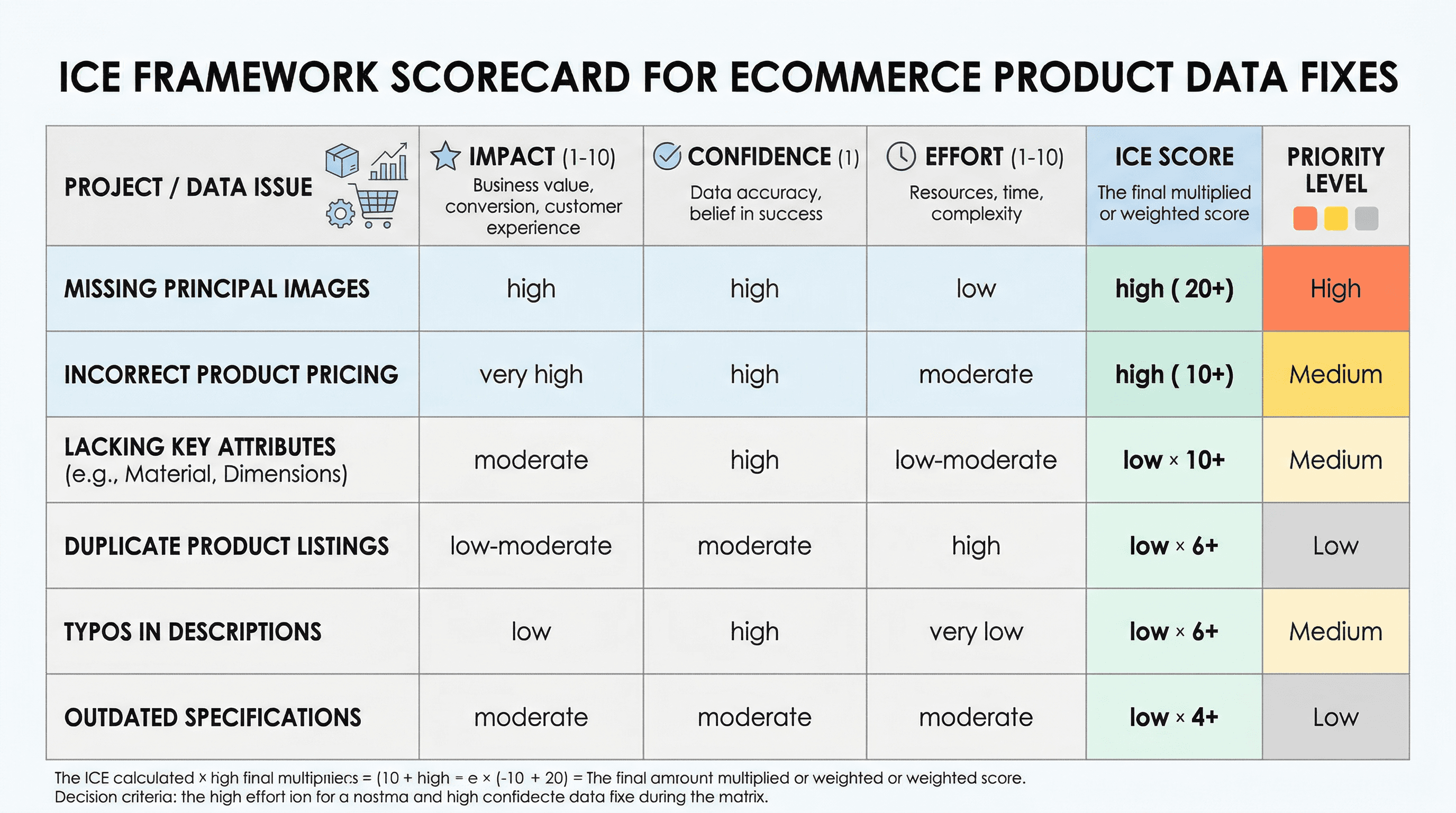
1. Define impact metrics
Choose measurable outcomes, such as retail search rank delta or lost sales. Map product content compliance into tier levels.
Concrete example: Missing brand name = 50 impact points. Missing lifestyle image = 5 impact points.
Typical error: Treating all content issues as having equal impact.
2. Estimate signal confidence
Weight the reliability of the signal coming from the analytics tool or marketplace API.
Concrete example: Marketplace API explicitly reports Error 8560: Missing primary image = Confidence 90. Scraping tool flags Title might be poorly optimized = Confidence 40.
Typical error: Promoting heuristic flags to high-confidence alerts.
Capture the time and cross-functional coordination cost required to deploy the fix.
Concrete example: Updating a standardized Color: Navy across a single listing = Effort 1. Family-wide variation restructuring = Effort 5.
Compute ICE and normalize
Compute the score as (Impact × Confidence) / Effort, then normalize it to a 0–100 scale.
Weekly sprint execution checklist:
- Export the failing SKUs from the digital shelf analytics layer.
- Apply the ICE formulas and normalize the scores.
- Build a top 50 triage list.
- Assign specific column-level owners.
- Execute fixes in a one-week sprint and review results.
QA, Governance, and Executive Reporting
A digital shelf analytics program is only viable if the operations team trusts the data. Establishing rigorous protocols for data integrity preserves the catalog's health.
Change logs and immutable audit trails
Good governance requires change logs recording who changed what, when, and where. Link all PIM change entries directly to the incident tickets.
Typical error: Allowing free-text notes instead of standardized reason codes.
Catalog sampling and quality checks
Perform a weekly stratified sampling routine based on revenue, units sold, and search rank. Include strict schema checks for mandatory fields.
Concrete example: Automatically sample 50 SKUs from the top revenue decile every Tuesday morning to verify weekend feed syndication.
A/B testing guardrails and safe experiments
Define minimum cohort sizes, holdback groups, and strict rollback criteria for any A/B tests on product pages. Review testing strategies for product content to understand safe deployment frameworks.
Frequent error: Running aggressive inventory-driven tests without setting a guardrail for stock depletion.
Rollback and incident playbooks
Document explicit rollback steps per channel. Always test rollbacks in a staging environment.
Concrete example: If Marketplace API rejects >15% of bulk update payload -> Trigger Runbook B -> Revert to previous day's snapshot in PIM.
- Quick wins applied: Highlight the volume of fixes deployed.
- Root cause analysis: Detail the origin of the top 3 persistent issues and identify the remediation owner.
- Next sprint focus: Outline the priority backlog for the upcoming week.
Scaling Digital Shelf Operations with ButterflAI
Managing product content compliance, retail search ranking discrepancies, and marketplace availability across multiple channels requires manual intervention that drains catalog teams. ButterflAI detects digital shelf anomalies automatically and orchestrates structured, approved content fixes directly into your PIM and Shopify stores, turning passive shelf signals into an active, resolved backlog.