
Ecommerce Operations
Digital Shelf Analytics: An Ops-First Playbook
Turn digital shelf signals like retail search ranking, product content compliance, and out-of-stock monitoring into a high-impact weekly sprint.
Feb 27, 2026
Read More
A practical data governance framework template to stop feed rejections, fix filter chaos, and organize your ecommerce product data in 30 days.

Product data governance is the system of rules, roles, and processes that ensures product attributes are accurate, consistent, and channel-ready. Put plainly: govern the fields and flows that power listings, filters, feeds, and product detail pages (PDPs) so you stop feed rejections, fix filter chaos, and deliver reliable customer experiences.
Why this matters: Focusing your governance scope strictly on what drives customer discovery and orderability reduces most catalog incidents without creating unnecessary overhead.
What to govern: Start with attribute tiers (required, recommended, optional) and document the data type, allowed values, and formatting examples for each. Govern variant logic with parent-child mapping and SKU inheritance rules so attributes like size and color behave consistently across the storefront. Record unique identifiers (GTIN, MPN, internal SKU) and map them to each marketplace or ad channel requirement. Define media rules for primary image sequence, minimum resolution, file type, and alt-text conventions. Finally, map source fields to channel feed fields and note any transformations applied during feed generation.
For example, when mapping unique identifiers, Amazon requires specific ASINs or standard GTINs, while Google Merchant Center might accept MPN combined with Brand if a GTIN is unavailable. Documenting these specific fallback rules prevents blanket feed rejections when launching new channels.
Concept Check:
Example:
Catalogs usually fail because of process, mapping, and ownership gaps rather than a missing tool. Missing or invalid identifiers cause immediate feed disapprovals on strict channels. Inconsistent attribute values (e.g., "Navy", "Dark Blue", "Blue") fragment filters and reduce discoverability. Incorrect variant mapping creates duplicate listings or prevents checkout entirely. Poor media management lowers conversion and increases return rates. Finally, sync failures between the PIM and storefront, combined with unclear ownership, make remediation painfully slow.
For strict channel rules, review the Google Merchant Center product data specification.
Actionable Checklist: Baseline Governance
Most catalog problems start with unclear ownership and inconsistent attributes. This 30-day template provides a compact plan to build a product data governance framework that stops feed rejections, fixes filter chaos, and produces consistent PDPs for web and marketplaces.
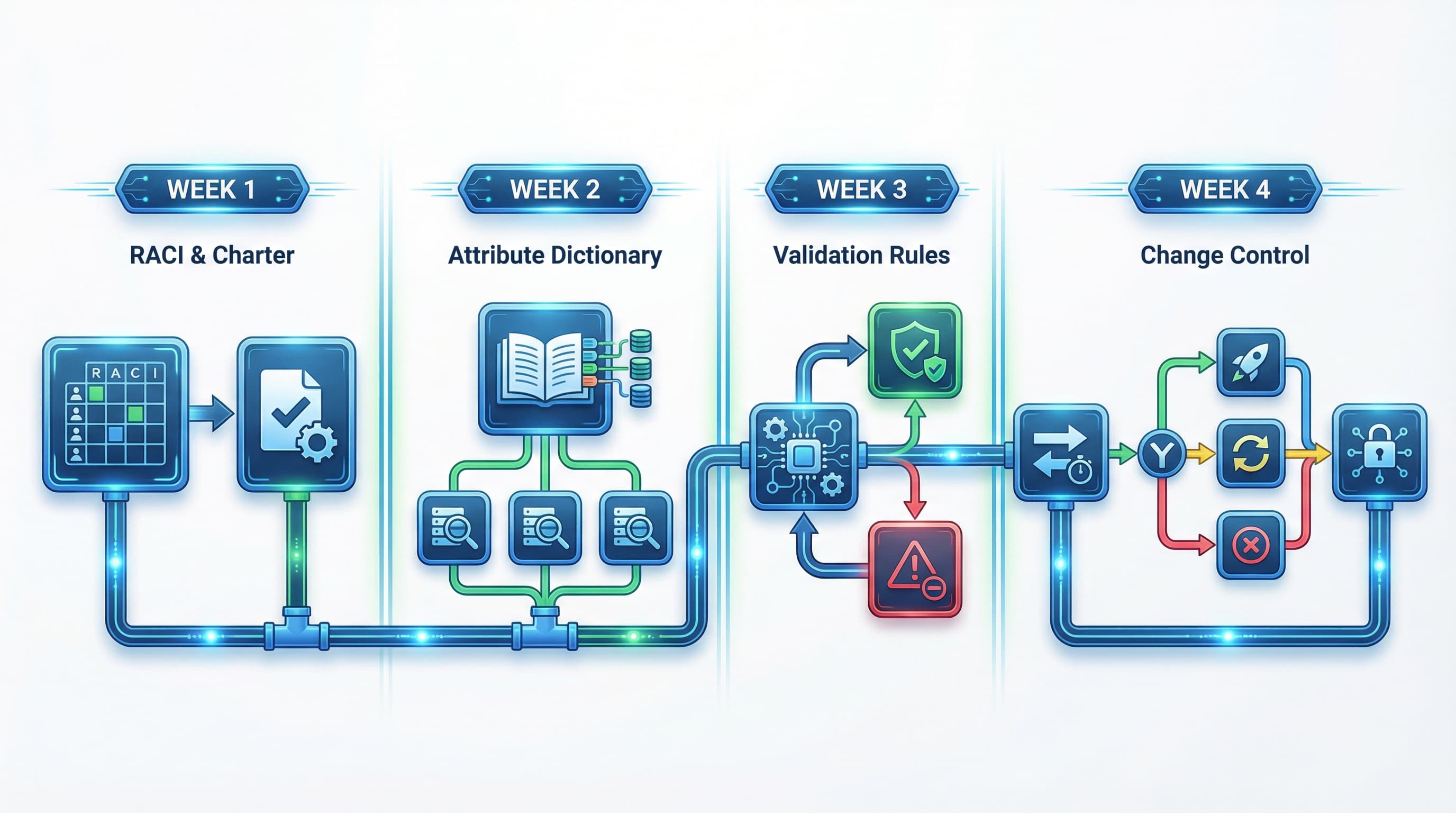
Why this matters: Quick alignment avoids busywork later and reduces the time spent fixing marketplace rejections post-launch.
How to approach it: Appoint a single catalog owner and gather stakeholders from merchandising, content operations, engineering, and paid acquisition. Create a shared workspace and export a sample of 500 SKUs that represent your catalog's complexity (top sellers, slow movers, and marketplace-heavy items).
Why this matters: A RACI matrix clarifies exactly who is responsible for data entry and who approves changes to product attributes.
How to approach it: Define roles (Responsible, Accountable, Consulted, Informed). Include specific owners for attribute taxonomy, images, GTINs, and pricing. Limit the initial scope to 10 high-impact attributes to maintain velocity: Title, Brand, GTIN, Category, Color, Size, Materials, Price, Availability, and Primary Image.
Example RACI Matrix:
Responsible (R): Catalog Specialist (creates and updates values).
Accountable (A): Head of Catalog (ensures quality and approves taxonomy changes).
Consulted (C): Merchandising and Legal (provides input on claims and categorization).
Informed (I): Marketing and Paid Acquisition (notified of feed structure changes).
Typical error: Overloading the Accountable role with too many approvers, stalling the workflow.
Why this matters: A clear attribute dictionary solves filter chaos and ensures a consistent search experience across endpoints.
How to approach it: For each attribute, list its definition, type, format, allowed values (or regex pattern), source system, priority, example value, and validation rule.
Template Snippet: Attribute Dictionary Entries
Attribute: Title
Type: Text
Format: Sentence (Title Case)
Allowed Values: N/A (Free text, but guided by naming convention)
Source: PIM
Priority: High (Required)
Example: "Running Shoe for Men - Lightweight Mesh"
Validation: Not empty AND length <= 150 characters
Attribute: Material
Type: Enumeration
Allowed Values: "Cotton", "Polyester", "Leather", "Synthetic"
Source: ERP or PIM
Validation: Must match allowed list exactly.
Typical error: Leaving allowed values undocumented for facet attributes (like color or material), resulting in messy frontend filters.
Why this matters: Validation rules catch issues before feeds reach external channels, drastically reducing rejection rates.
How to approach it: Translate your attribute dictionary rules into automated validations within your PIM, integration layer, or feed management tool. Common validations include required presence, regex patterns for GTINs, enumerations for category paths, and image resolution checks.
Example Validation Rules:
GTIN: Regex for numeric 8-14 digits.
Title: Not empty AND max 150 characters.
Primary Image: Resolution minimum 800x800px.
Typical error: Only running validations at the very end of the pipeline, making it hard to identify which source system introduced the error. For practical scenarios, check this Merchant Center feed rules primer.
Why this matters: Controlled changes prevent accidental taxonomy drift and unexpected feed breaks during peak sales periods.
How to approach it: Implement a lightweight approval workflow. Changes to the attribute dictionary must pass an approval ticket that includes an impact assessment and sample SKUs. Schedule a weekly digest of approved changes and always have a rollback plan.
Example Approval Workflow:
Measure Success: Track the feed rejection count, transactions lost due to rejections, and facet complaint tickets before and after the 30-day window.
Product data governance must be lightweight and pragmatic. A heavy, enterprise-level setup will slow down eCommerce operations. This architecture keeps rules close to authorship points and adds a final safety gate before publishing to storefronts.
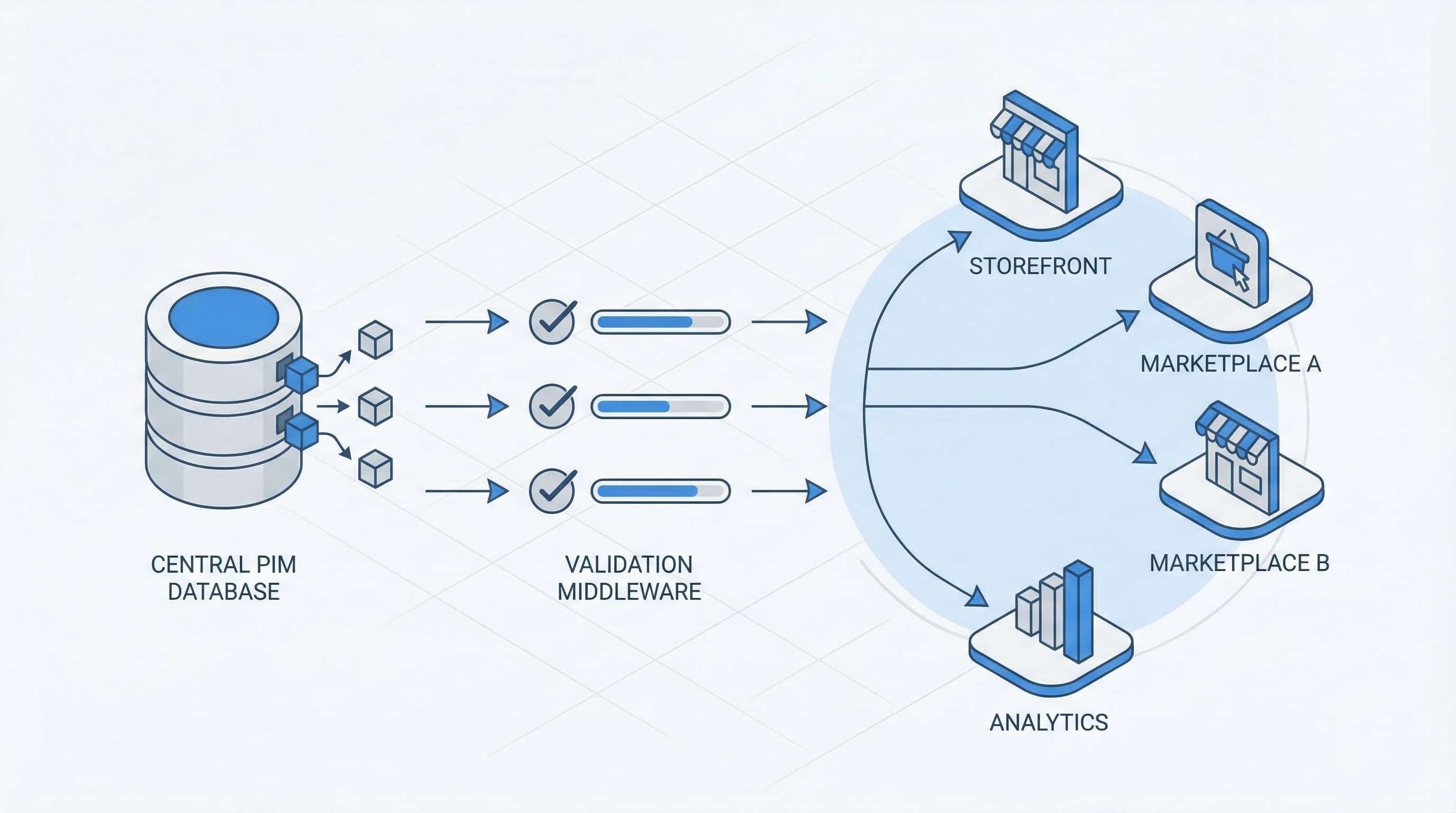
Centralizing attributes, media, and taxonomies in a PIM ensures that errors are corrected once and do not replicate downstream to marketplaces or ads.
Common approach:
Example:
Typical error:
Put primary validations in upstream systems where data is authored. Primary validations include attribute presence, data type checks, and allowed value enforcements.
Keep lightweight, service-side checks in the integration layer to verify mapping integrity and implement business rules that are strictly channel-specific. This reduces repeated manual fixes across different marketplaces.
What to validate upstream:
A practical, resilient data pipeline relies on three main gates:
If a pre-publish check in staging fails due to a missing required metafield (like 'care_instructions' for an apparel theme), the pipeline should halt the sync for that specific SKU rather than failing the entire batch, allowing the rest of the catalog to update successfully.
This architecture reduces rework by catching errors at the cheapest point to fix (data entry) and keeps catalog operations focused on data quality rather than putting out daily fires.
Governance frameworks fail if they only exist in spreadsheets. Scaling requires turning rules into operational workflows using QA sampling, targeted dashboards, and safe automation.
Why this matters: Sampling finds systemic errors before they hit feeds, protecting your channel health scores.
Set up random and risk-based sampling across your source systems, categories, and change types. Risk-based sampling targets high-impact attributes such as price, GTIN, and availability. Implement automated sampling jobs in your PIM or ETL tool that output failures directly to an issue tracker.
Example: A nightly script selects 200 SKUs from 10 high-risk categories and flags any missing required attributes for manual review the next morning.
Typical error: Only sampling best-sellers, which allows long-tail defects to accumulate and trigger marketplace warnings.
Why this matters: Dashboards turn static rules into actionable operational signals.
Track rule hit rates, feed rejection trends, attribute completeness by channel, and average time-to-fix. Create drillable views that link directly to the offending SKUs. If a dashboard flags that 15% of your new season inventory is missing primary images, a catalog manager should be able to click through to see exactly which vendor failed to upload the assets, drastically cutting down investigation time.
Use BI tools or near-real-time monitoring in your feed pipeline, and integrate alerts into your issue tracker so every breach becomes a trackable ticket.
Example: A KPI dashboard shows a sudden spike in marketplace rejections for the "Size" attribute. The catalog manager filters the view down to three specific suppliers and opens corrective tasks immediately.
Typical error: Reporting vanity metrics (like total SKU count) without linking data quality to business impact (like lost visibility or blocked checkout). For best practices on custom data endpoints, review guidelines on managing Shopify metafields.
Why this matters: SLAs stop small mapping problems from becoming systemic catalog failures.
Define priority tiers, assign owners, and set escalation paths in a RACI that covers catalog operations, supplier operations, and development. Automate owner assignment based on the category or source feed, and set clear time windows for acknowledgment and resolution.
Triage Checklist:
Typical error: Relying on manual email routing to a shared inbox, which creates bottlenecks and delayed responses.
Why this matters: AI dramatically increases throughput for product descriptions and attribute extraction, but it requires strict guardrails to prevent hallucinations from reaching live listings.
Treat AI output as suggestions that must be labeled, versioned, and staged. Enforce the same rule-based validations that you use for human entry—checking allowed values, regex patterns, and marketplace policies—before publishing. Always keep provenance metadata (tagging data as AI-generated) and maintain a clear rollback path.

Example: A generative AI model completes missing bullet points for a new apparel line, but an automated validation rule blocks the push because the AI included prohibited promotional claims ("Free Shipping") and pricing statements.
Typical error: Publishing AI output directly to Shopify or Merchant Center without provenance tracking or validation, inevitably triggering feed rejections and compliance warnings.
Building dictionaries, mapping metafields, and enforcing manual QA processes takes significant time—often pulling teams away from actual growth initiatives. When governance is purely manual, enforcement slips, and catalogs degrade over time.
ButterflAI automates this operational overhead entirely. Instead of managing complex spreadsheets and manual validation rules, ButterflAI continuously audits your product data, instantly mapping attributes, normalizing variants, and enriching missing fields safely. It applies best-practice governance directly within your Shopify and PIM ecosystems, ensuring your catalog remains channel-ready, fully compliant, and optimized for discovery.
Quick answers to common questions.
Turn digital shelf signals like retail search ranking, product content compliance, and out-of-stock monitoring into a high-impact weekly sprint.
Feb 27, 2026

Master the math and data operations behind product bundling to increase AOV without eroding your margins or creating catalog chaos.
Feb 9, 2026

Operational guide to mastering product bulk edits, variant mapping, and metafield management without breaking your store.
Jan 28, 2026
